

If you run a physio, chiro, osteo, podiatry or psychology clinic in Australia, you know the pattern. The phone rings while everyone is with a patient, the caller hangs up, and by the time someone rings back they've booked somewhere else. An AI receptionist can pick those calls up, but finding the best AI receptionist Australia clinics can use is harder than it looks. Most tools were built for American trades businesses and law firms.
Every missed call is a new patient or a rebooking your diary never sees. The questions that matter are plain: does it book into your practice software, can it use an Australian number, where is call data stored, and what happens when a caller asks for a person?
This list compares seven options: AI-first tools, an Australian answering service staffed by people, and a few global names. We checked prices, trials, numbers and integrations on each vendor's own website in October 2026, quoting prices in the currency each one uses.
Best AI receptionists in Australia: a quick overview
- Chimehill: best for allied-health clinics on Cliniko, Splose, PracSuite or Nookal that want the booking made in the diary during the call.
- Virtual Headquarters: best if you want an Australian person answering every call.
- Trillet: best for solo practitioners who book from a calendar and want a low monthly price.
- Open: best for larger practices that want Australian data hosting and links to their phone and helpdesk systems.
- Frontdesk (My AI Front Desk): best for clinics whose callers speak many languages.
- Smith.ai: best if you want AI first with live receptionists as backup, for non-clinical calls.
- Dialzara: best for trying AI answering cheaply before you commit.
| Tool | Best for | Books into practice software? | Price (as of October 2026) |
|---|---|---|---|
| Chimehill | Allied-health clinics on four AU practice systems | Yes: Cliniko, Splose, PracSuite, Nookal | From A$249 a month for 100 calls, excl. GST |
| Virtual Headquarters | A person on every call | Says it can work in your practice software; none named | Receptionist plans from A$80 a month for 20 calls, plus GST |
| Trillet | Solo practitioners on a budget | Books into a connected calendar; Google Calendar named | US$49 a month for 150 minutes |
| Open | Larger practices wanting AU data hosting | Books into a live calendar; no practice software named | Voice pricing for Australia not published |
| Frontdesk | Callers in many languages | North American therapy software (WebPT and others); no AU systems listed | US$99 a month for 200 minutes |
| Smith.ai | AI first, people as backup | Calendly named; no patient record system named | Free for 25 calls; Pro from 150 dollars a month for 75 calls |
| Dialzara | A cheap first try | Google Calendar and Outlook | From US$29 a month for 60 minutes |
1. Chimehill: best for allied-health clinics on Cliniko, Splose, PracSuite or Nookal
Chimehill is an AI receptionist built only for independent allied-health clinics: physio, chiro, osteo, podiatry, psychology and similar practices in Australia, the UK and New Zealand. It picks up when your team can't (mid-treatment, at lunch, after hours and at weekends), books and changes appointments in your practice software, answers the questions you've approved, and passes everything else to your team with a summary.
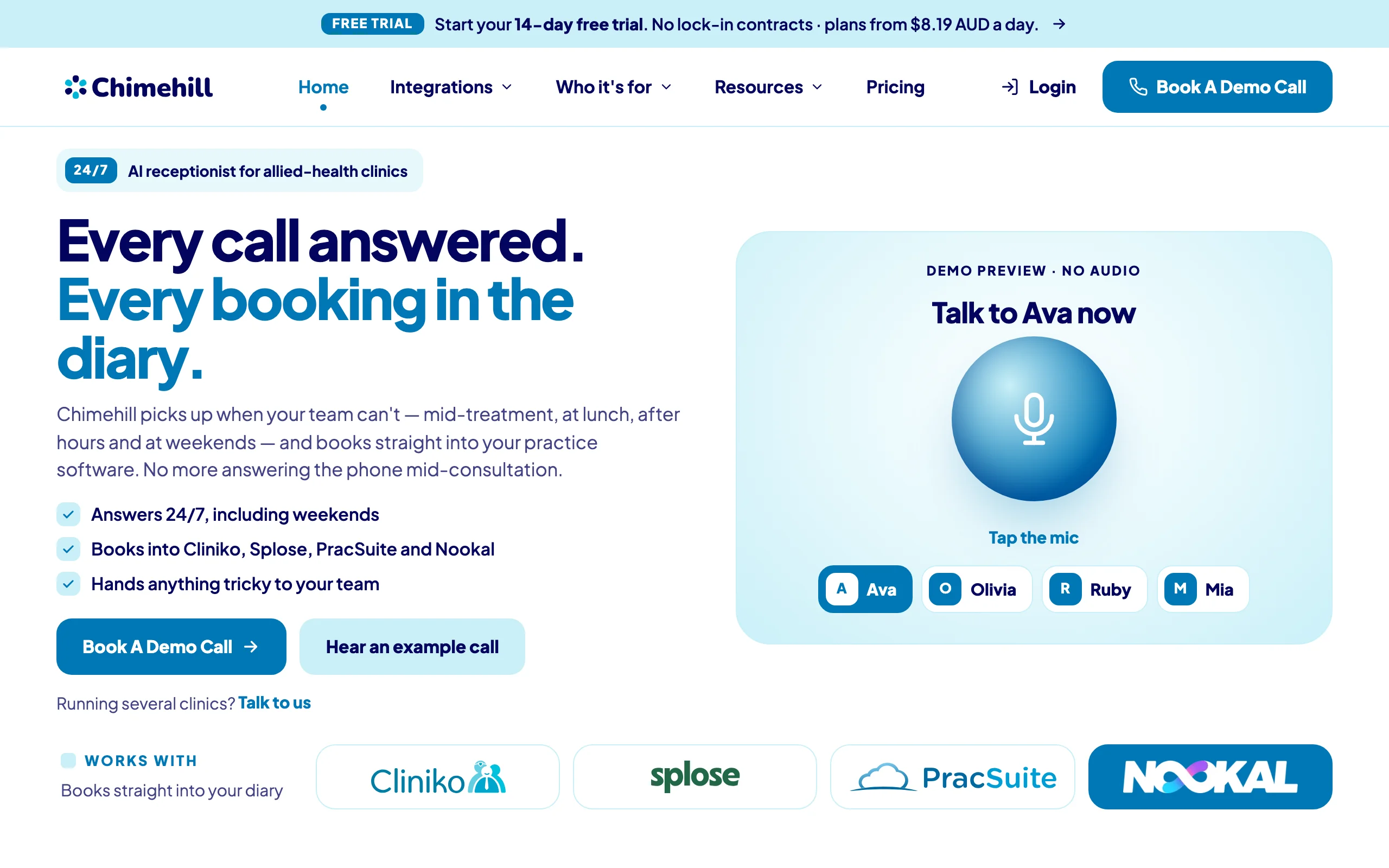
You keep your clinic's number and forward calls to it: all of them, only the overflow when the desk is busy, or only after hours. It introduces itself as your clinic's virtual receptionist, so callers know they're talking to an AI, and anyone who asks for a person gets one, either by transfer or a callback task for your team.
Key features
- Books into Cliniko, Splose, PracSuite and Nookal, offering real free slots and re-checking the slot just before it saves
- Never tells a caller "you're booked" until your software confirms it; if the save fails, the caller hears it isn't confirmed and gets a callback
- You choose which appointment types and practitioners it can book
- Checks name and date of birth before finding or changing a booking, because caller ID alone isn't proof
- Answers only from your approved notes and never makes up prices or availability
- Administrative only: urgent language follows an escalation script your clinic approves
Pricing (as of October 2026, Australian dollars, excluding GST)
- 100 calls a month: A$249
- 200 calls a month: A$379
- 350 calls a month: A$579
- Each extra call: A$2.70
- 14 days free on every plan, no lock-in contract
Outbound calls get the same allowance as inbound. The pricing page also shows the plans in pounds and New Zealand dollars.
Pros
- The only tool in this list built around Cliniko, Splose, PracSuite and Nookal
- Priced per call, so a long call about a family booking costs the same as a quick one
- Clear rules on bookings, identity checks and handover that suit a health setting
Cons
- Works with four practice systems only; if you're on something else, it can't book for you yet
- English only, and it hasn't yet published where call data is hosted, which some Australian clinics will want to know before they sign
If you'd like to hear it answer as your clinic, book a demo.
2. Virtual Headquarters: best if you want an Australian person answering every call
Virtual Headquarters (Virtual HQ) is an Australian business based in North Sydney that sells virtual offices and human phone answering. It isn't an AI receptionist: your calls go to trained Australian receptionists. It's here because plenty of clinic owners searching for an AI receptionist really want a person on the line, and Virtual HQ lists allied health, physio, chiro and psychology among the industries it serves.
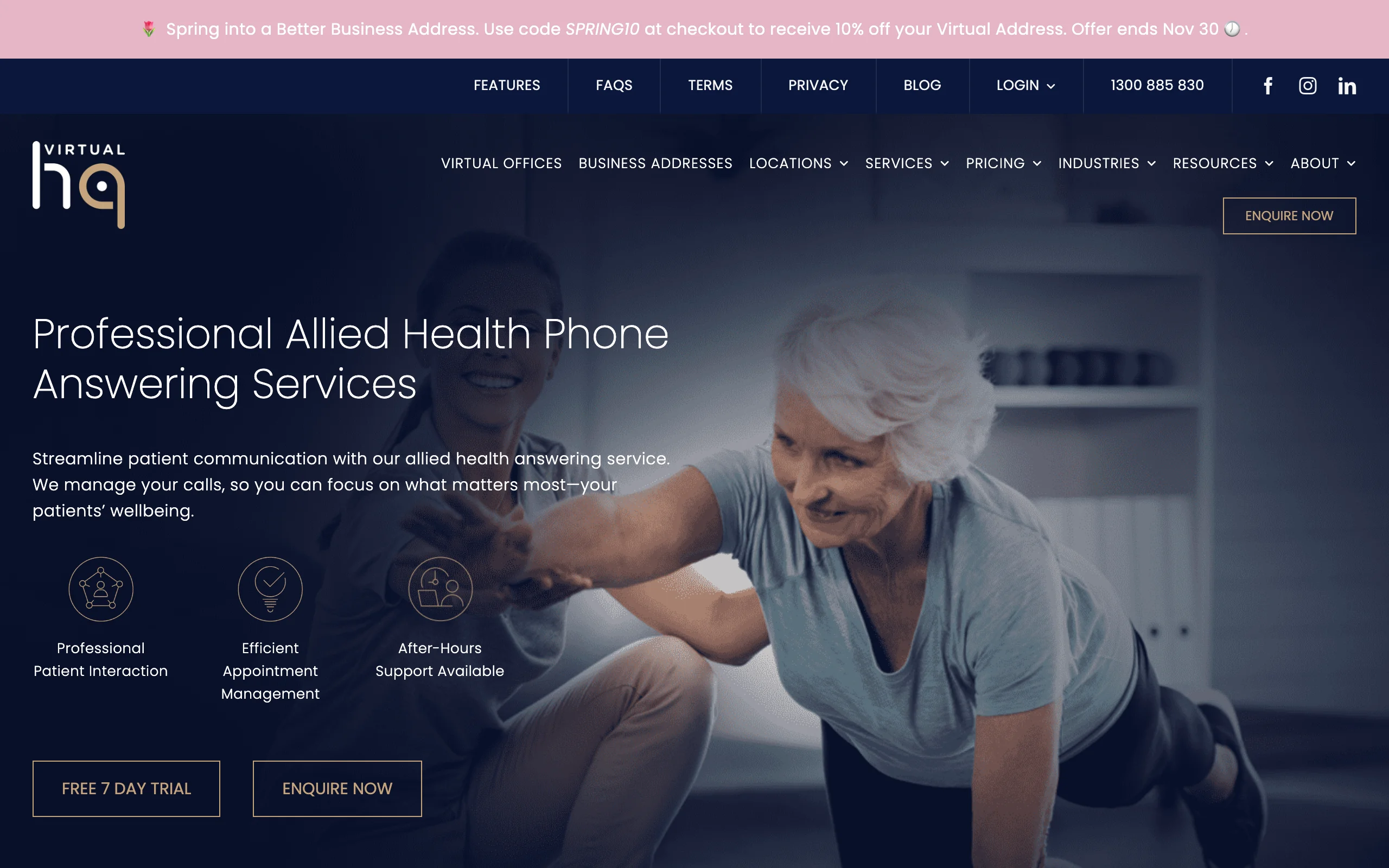
Its allied-health page says the receptionists take calls, manage appointments and answer patient queries, and that its diary service "can integrate with your practice management software" to book, reschedule or cancel. It doesn't name which software, so ask before you sign up. It advertises 24/7 answering, with after-hours calls taken as messages or escalated using your own instructions.
Key features
- Australian-based receptionists, 24/7
- Message taking with email or SMS after each call
- Diary management plans for booking, rescheduling and cancelling
- Optional 1300 or 1800 numbers
Pricing (as of October 2026, Australian site, prices plus GST)
- Virtual Receptionist 20: A$80 a month for 20 calls, then A$3.99 a call
- Virtual Receptionist 50: A$185 a month for 50 calls, then A$3.99 a call
- MyDiary plans (bookings): from A$49 a month, charged at A$2.99 a minute, with a set-up fee from A$99
- 7-day free trial, no lock-in contract
Pros
- A real person on every call, which some patients prefer
- Australian staff and an allied-health page that speaks to clinics
- Published prices and a free trial
Cons
- Per-call and per-minute charges add up quickly in a busy clinic
- No practice software named on its pages as of October 2026, so check yours is supported
3. Trillet: best for solo practitioners who book from a calendar
Trillet is an AI receptionist for small businesses that describes itself as proudly Australian owned. One plan covers solo owner-operators, and the same company sells a white-label platform for agencies and an enterprise service. Its examples include a dental studio and a physio clinic alongside a plumber, so it's a general small-business tool rather than one made for clinics.
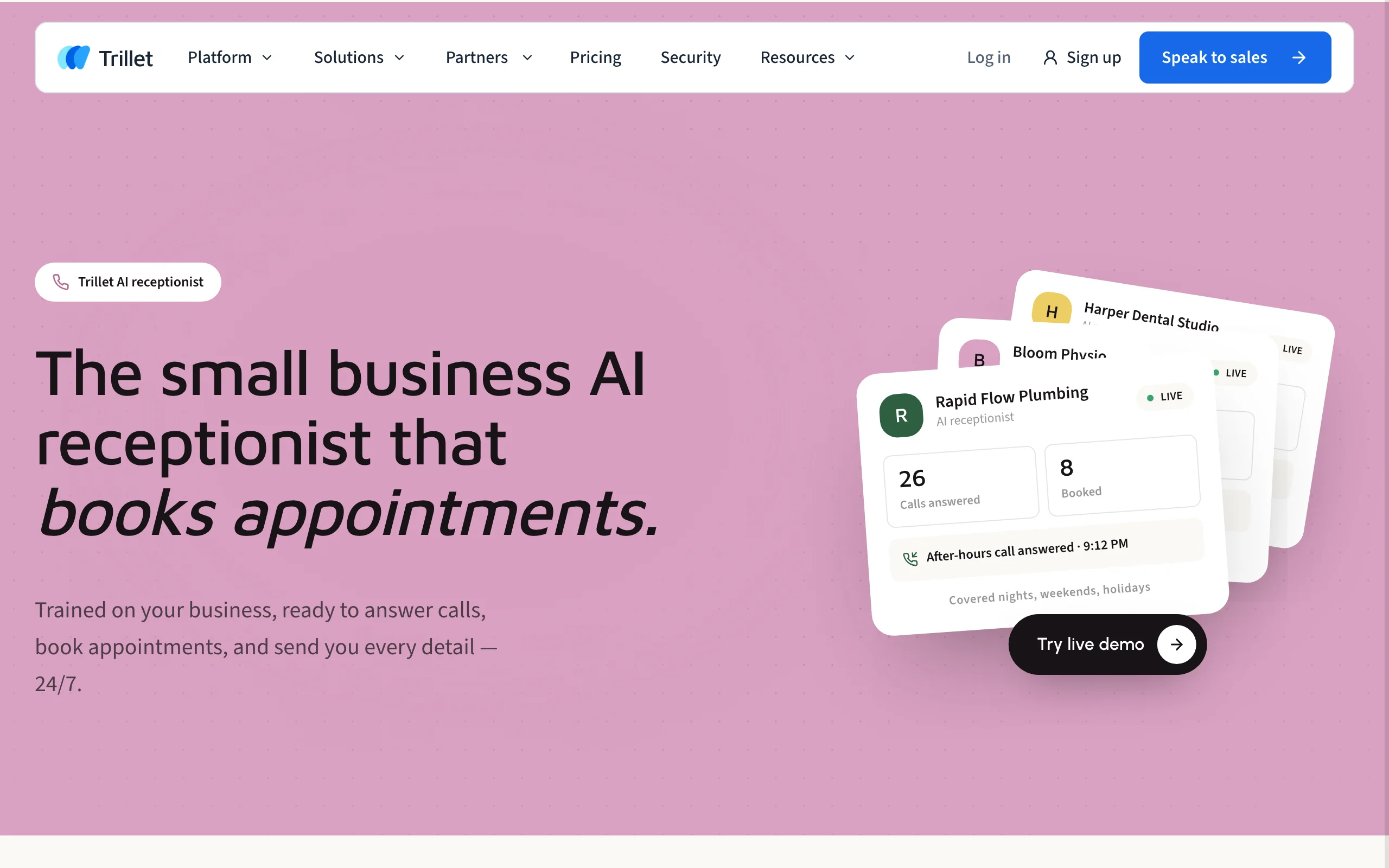
On a call it checks your connected calendar, books the slot and sends the caller an SMS confirmation, then emails you a summary with the caller's name, number and reason for calling. Its site lists Australian data residency as available, and its enterprise tier offers hosting in APAC, North America or EMEA.
Key features
- Books into a connected calendar, with Google Calendar named among its integrations
- SMS confirmation to the caller after a booking
- Emailed summary after every call
- Keep your existing business number
Pricing (as of October 2026, US dollars)
- AI Receptionist: US$49 a month for 150 minutes, then US$0.20 a minute
- SMS: US$0.02 per message sent
- No contract, no set-up fee, 28-day money-back guarantee
Pros
- Low monthly price with published rates
- Australian ownership and Australian data residency listed on its site
- Money-back guarantee instead of a trial
Cons
- No practice software such as Cliniko named, so bookings go into a calendar, not your patient records
- Transfer to a person isn't described for the receptionist plan as of October 2026
4. Open: best for larger practices that want Australian data hosting
Open (open.cx) is an AI customer service company backed by Y Combinator that sells a voice product it calls an AI answering service for Australia. It names clinics alongside small businesses and trades as its audience, says the voice is tuned for Australian English, and offers Australian data hosting in Sydney.
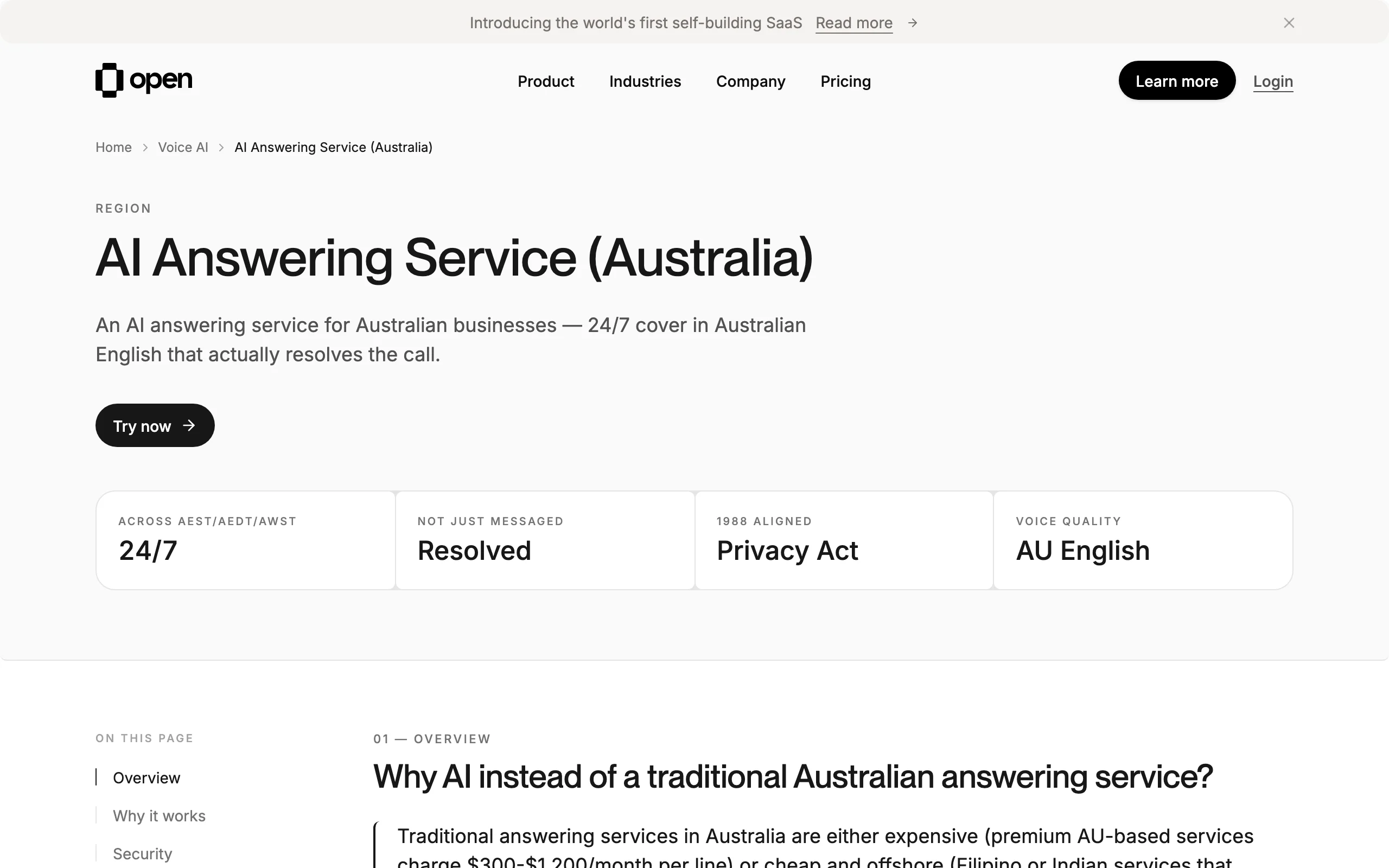
Open is built for teams that already run phone and helpdesk software. It names Telstra, Optus and MyNetFone, plus Aircall, RingCentral, 8x8 and Zoom Phone, and helpdesks such as Zendesk, HubSpot and Salesforce. It says it can book into a live calendar and hand calls to a person when needed, giving "clinical decision" as an example of a call that needs a human.
Key features
- Australian English voice, 24/7
- Australian data hosting in Sydney available
- Links to Australian phone carriers and business phone systems
- Hands off to a person when a call needs one
Pricing (as of October 2026)
- Voice pricing for Australia isn't published; you talk to sales
- Its general pricing page lists 0.75 to 0.90 per resolved ticket, without naming a currency
- No free trial listed; it offers a refund guarantee for the first 120 days
Pros
- One of the few tools here to publish an Australian data hosting option
- Works with the phone systems many Australian practices already use
Cons
- No practice software named, so it won't book into Cliniko or similar on its own
- Pricing isn't published for Australian voice, and the set-up suits practices with an IT or operations person
5. Frontdesk (My AI Front Desk): best for clinics whose callers speak many languages
Frontdesk, also known as My AI Front Desk, is an AI receptionist that answers calls, texts, chat and email. It's a large general-purpose tool with industry pages for property, retail and therapy practices. You can reserve an Australian number for it; its help pages list the US, Canada, the UK and Australia as the four main countries, with number verification taking two to three business days.
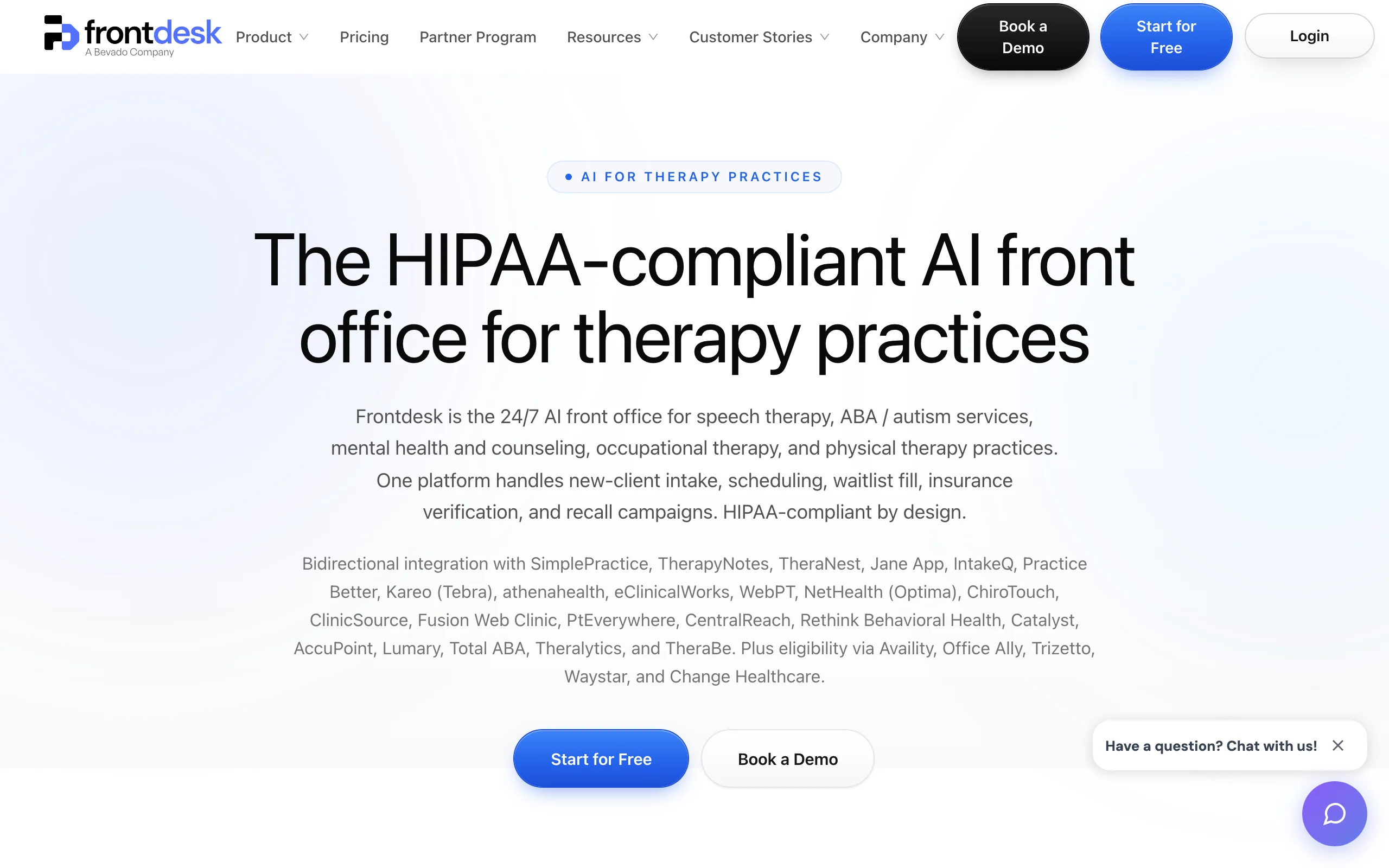
Its therapy page lists two-way integrations with North American practice software such as WebPT, SimplePractice and TherapyNotes, and covers physical therapy, occupational therapy, speech therapy and mental health. None of the Australian systems (Cliniko, Splose, PracSuite or Nookal) is listed, so an Australian clinic would usually be booking into a calendar or using Zapier.
Key features
- Australian phone numbers available
- More than 20 languages
- Calls, texts, web chat and email in one place
- Zapier on every plan
Pricing (as of October 2026, US dollars)
- Business-in-a-Box: US$99 a month, or US$79 a month billed annually, with 200 voice minutes
- Extra minutes are paid from credits (25 credits a minute, 1 credit = US$0.01)
- 7-day free trial; no permanent free plan
Pros
- Wide language support, useful in multilingual suburbs
- Australian numbers and a low entry price
- Integrations with therapy software for practices outside Australia
Cons
- No Australian practice software listed as of October 2026
- Built around US healthcare rules (HIPAA), which don't answer Australian Privacy Act questions
6. Smith.ai: best for AI first with live receptionists as backup
Smith.ai is a North American answering service with two options: AI-first, where an AI answers and a live receptionist steps in, and human-first. Its named integrations lean towards law firms and general small businesses.
The detail Australian clinics need is on its medical page: "Smith.ai is not HIPAA-compliant and cannot handle protected health information (PHI) in regulated healthcare environments." It points that service at veterinary and wellness businesses instead. Its pricing page doesn't mention Australia, and its live backup is described as "North America-based".
Key features
- AI answering with live receptionists as backup
- Test and simulated calls on every plan
- Calendly, Clio and Zapier named
- Up to 10% of calls a month can be removed from billing as spam
Pricing (as of October 2026, dollars with no currency code shown; Smith.ai is North American)
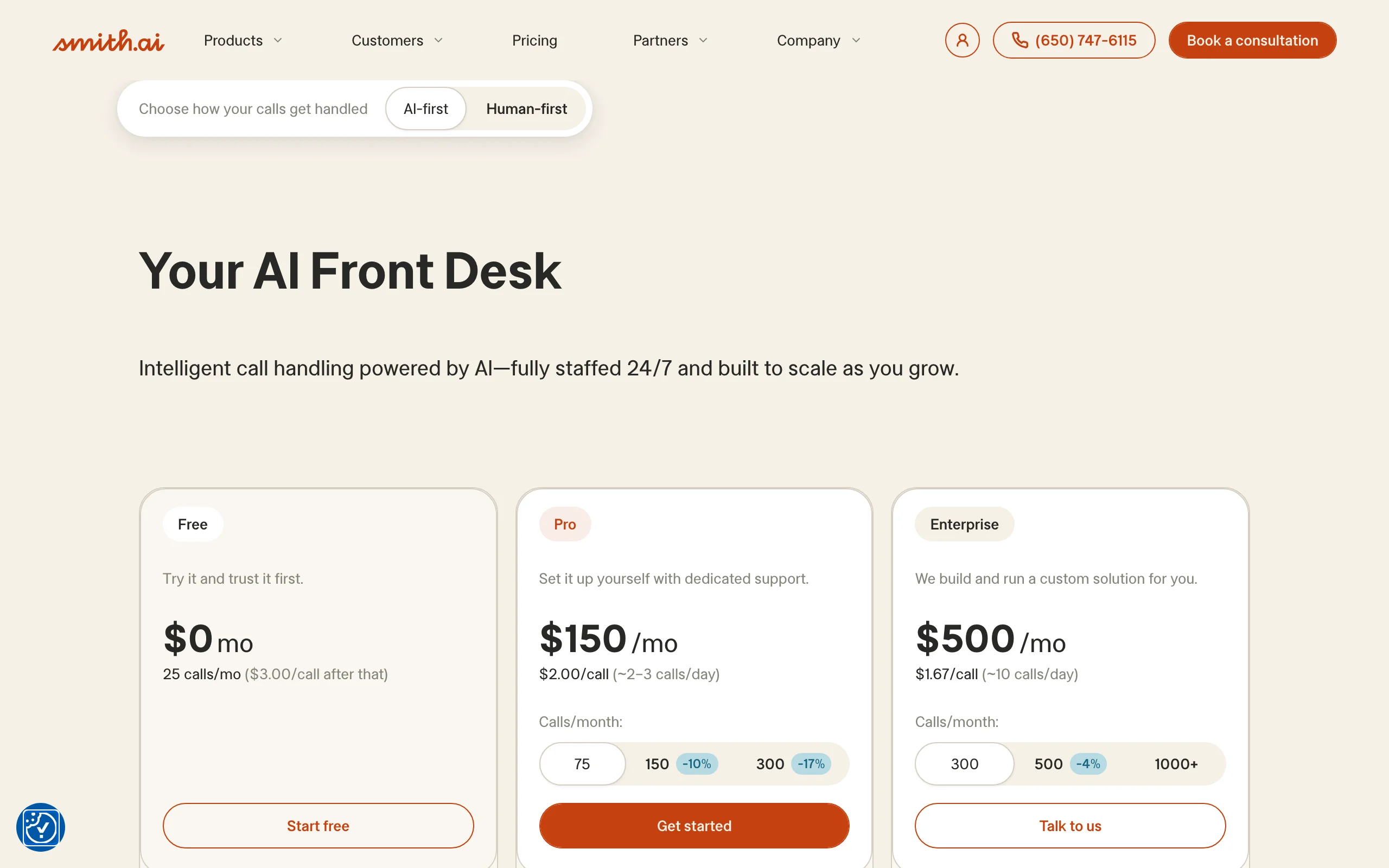
- Free: 0 dollars for 25 calls a month, then 3.00 dollars a call
- Pro: 150 dollars a month for 75 calls, with larger call tiers available
- Enterprise: 500 dollars a month from 300 calls
- Month to month, with 30 days' notice to cancel
Pros
- A free plan to test with
- People available when the AI can't help
- Clear per-call pricing
Cons
- Says it can't handle protected health information, so it's a poor fit for patient calls
- No Australian numbers or Australian staff mentioned as of October 2026
7. Dialzara: best for a cheap first try
Dialzara is an AI receptionist for small businesses that answers 24/7, books appointments, screens spam and emails you a summary of each call. Its plans are simple and cheap, which makes it an easy way to hear what an AI receptionist sounds like on your own calls.
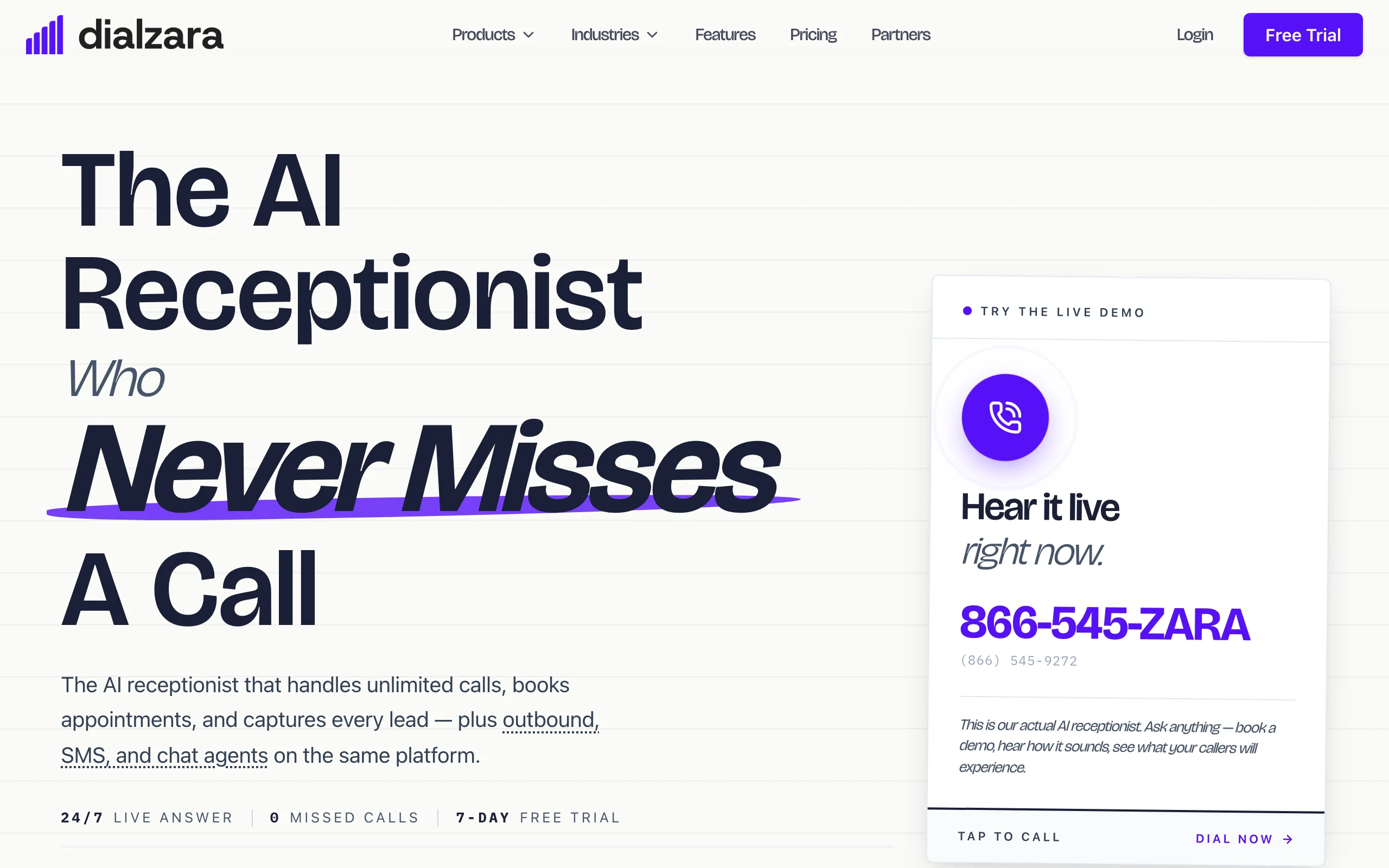
It works with Google Calendar and Microsoft Outlook, and lists more than ten languages. Australian clinics should check the phone side first: its FAQ lists US local and US toll-free numbers only, and doesn't mention Australia. For regulated work, such as healthcare practices handling patient information, it asks you to contact sales before going live.
Key features
- Books into Google Calendar or Outlook
- Transfers by call type, spam screening, emailed call summaries
- More than ten languages
- Free number porting
Pricing (as of October 2026, US dollars)
- Business Lite: US$29 a month for 60 minutes, then US$0.48 a minute
- Business Pro: US$99 a month for 220 minutes
- Business Plus: US$199 a month for 500 minutes
- Business Elite: US$349 a month for 1,000 minutes
- 7-day free trial, no set-up fees, cancel any time
Pros
- The lowest entry price in this list
- Published per-minute rates
Cons
- Only US numbers listed as of October 2026
- No practice software named, and healthcare use needs a conversation with sales first
How to choose an AI receptionist for your Australian clinic
Most clinics can narrow this list in a few minutes. These are the questions that matter most.
Does it book into your practice software?
This decides more than anything else. A tool that books into a Google calendar still leaves someone to copy the appointment into Cliniko or Nookal, check the practitioner, and fix double-bookings. Ask every vendor which practice software it books into, whether the slot is checked again before it's saved, and what the caller hears if the save fails.
- If you're on Cliniko, Splose, PracSuite or Nookal and want bookings made during the call, look at Chimehill.
- If you're happy for a person to book by hand, Virtual Headquarters fits.
- If you only use a calendar, Trillet or Dialzara will do the job.
Does it work in Australia?
Check three things: can you get or forward an Australian number, does the voice suit Australian callers, and where is call data stored. Under the Privacy Act, health service providers are covered even when they're small businesses, and the OAIC expects you to think about overseas disclosure before you use an AI product. A HIPAA badge is a US standard and doesn't answer that question. Trillet and Open publish Australian data hosting options; for every other tool here, including Chimehill, ask in writing.
What happens when a caller wants a person?
Some calls need a human: an upset patient, a complicated insurance question, someone who simply prefers people. Ask how each tool hands over (a live transfer or a callback task) and test it yourself. If you want a person on every call, an answering service like Virtual Headquarters is the honest choice, even though it costs more per call.
How is it priced?
AI receptionist cost in Australia comes in three shapes: per call (Chimehill, Smith.ai), per minute (Trillet, Frontdesk, Dialzara) and per call with a person (Virtual Headquarters). Per-minute plans look cheaper until a caller spends six minutes rearranging a family's appointments. Take last month's call count and average length, then work out each option. Our plans are priced by calls a month for that reason.
Can you test it before patients hear it?
Every option here offers a trial, a free plan, a demo or a refund guarantee. Use it properly: ring after hours, ask for a price you haven't approved, try to cancel without giving a date of birth, and ask for a person. How it handles those calls tells you more than any feature list.
Questions clinics ask
What is the best AI receptionist in Australia for a clinic?
It depends on your practice software. If you use Cliniko, Splose, PracSuite or Nookal and want bookings made during the call, Chimehill is built for that. If you want a person on every call, an Australian answering service such as Virtual Headquarters suits better. Start by listing which software you'd need it to book into.
How much does an AI receptionist cost in Australia?
As of October 2026, the tools in this list run from about US$29 a month (Dialzara, US numbers) to A$579 a month for 350 calls (Chimehill's largest plan), with some enterprise options priced on request. The fair comparison is cost per call at your clinic's real volume, so pull last month's call log before you compare.
Is an AI medical receptionist allowed to give clinical advice?
It shouldn't. A safe AI receptionist for a clinic handles admin: bookings, approved answers and messages. Clinical questions and anything urgent should go to your team through a script your clinic approves. Ask each vendor what happens when a caller describes symptoms.
Do we need to change our clinic's phone number?
Usually not. Most of these tools work by forwarding calls from your existing number, either all calls, only when the desk is busy, or only after hours. Check whether the tool gives you an Australian number for forwarding, as some list US numbers only.
Does the Privacy Act apply to small clinics using an AI receptionist?
Yes. The OAIC says health service providers are covered by the Privacy Act even if they're small businesses, and its guidance on AI products asks you to update your privacy notice and consider where data goes overseas. Ask each vendor where call recordings and transcripts are stored before you sign.
Will patients know they're talking to an AI?
They should. A good AI receptionist says it's a virtual receptionist at the start of the call and lets the caller ask for a person at any time. If a vendor can't tell you how it introduces itself, treat that as a warning sign.
Can an AI receptionist handle after-hours calls?
Yes, that's where most clinics start. Forward calls after closing time, let it book or take messages overnight, and check the summaries each morning. Once you trust it, you can add overflow during the day. The AI receptionist for clinics page explains how that set-up works.