
Dental phones ring most when the desk is busiest. Monday brings the weekend's toothaches, recall texts set off a run of hygiene bookings, and the receptionist on shift is taking payment for a crown. At 7pm on a Friday, a patient with a cracked molar gets voicemail and rings the next practice instead. That is the call a dental answering service is there to catch.
Whether a person or an AI answers matters less than what happens next: who takes the toothache at 9pm, and whether the booking lands in your diary or in a message someone types up in the morning. Only a couple of services can write into Dentrix or Open Dental, and none of the dental pages we read named Dentally, Software of Excellence, Pearl, Dental4Windows or Core Practice.
We compared seven services on bookings, emergency calls, hours and price, using each provider's own site in October 2026. Where a US company shows a bare "$", it's written here as US$.
Best dental answering services: a quick overview
- Chimehill: best for dental practices in the UK, Australia and New Zealand that want an AI on the phones day and night, with reception making the bookings. Priced per call in pounds, Australian or NZ dollars.
- Frontdesk (My AI Front Desk): best cheap AI for American offices running Dentrix, Eaglesoft or Open Dental, the three systems its dental page says it books into live.
- Abby Connect: best for American offices that want a person on new-patient and emergency calls and AI on the routine ones, on a single bill.
- Mango Voice: best for American offices ready to change phone system, with an AI called Margo that leaves callback tasks in the practice software.
- Specialty Answering Service: best for American offices that want live operators at the lowest published price, charged by the second.
- FFB: best for UK dental practices that want British receptionists covering weekday evenings and both weekend days.
- Moneypenny: best for UK practices that want an AI first, with Moneypenny's own healthcare receptionists behind it.
| Service | Who answers | Books into dental software? | Price (as of October 2026) |
|---|---|---|---|
| Chimehill | AI, then your own team | No: your team books from the call notes | £129, A$249 or NZ$249 a month for 100 calls (before VAT or GST) |
| Frontdesk | AI | Live booking in Dentrix, Eaglesoft and Open Dental, per its dental page | US$109 a month (dental page) or US$99, US$79 billed yearly (pricing page) |
| Abby Connect | People and AI | Dentistry Dashboard, Dengro and calendars; no Dentrix or Open Dental named | US$165 a month for 50 minutes and up |
| Mango Voice | AI on its own phone system | Leaves callback tasks in your practice software; Dentrix, Eaglesoft, Open Dental among 40+ named | US$449 a month for the plan with the AI |
| Specialty Answering Service | People | Uses your calendar or one it provides | US$44 a month and up, billed by the second |
| FFB | People, based in the UK | Books for you; software not named | About £200 a month for its most popular package |
| Moneypenny | AI, backed by UK receptionists | "Directly into your system"; dental systems not named | AI from £49 a month; healthcare answering quoted |
1. Chimehill: best for dental practices in the UK, Australia and New Zealand that want an AI on the phones day and night, with reception making the bookings
Chimehill is an AI receptionist for independent practices in the UK, Australia and New Zealand. You forward your number to it for all calls, for overflow when the desk is busy, or only once you've closed, and it answers at 2am on a Sunday the same way it answers at 10am on a Tuesday. Patients keep dialling the number they already have.
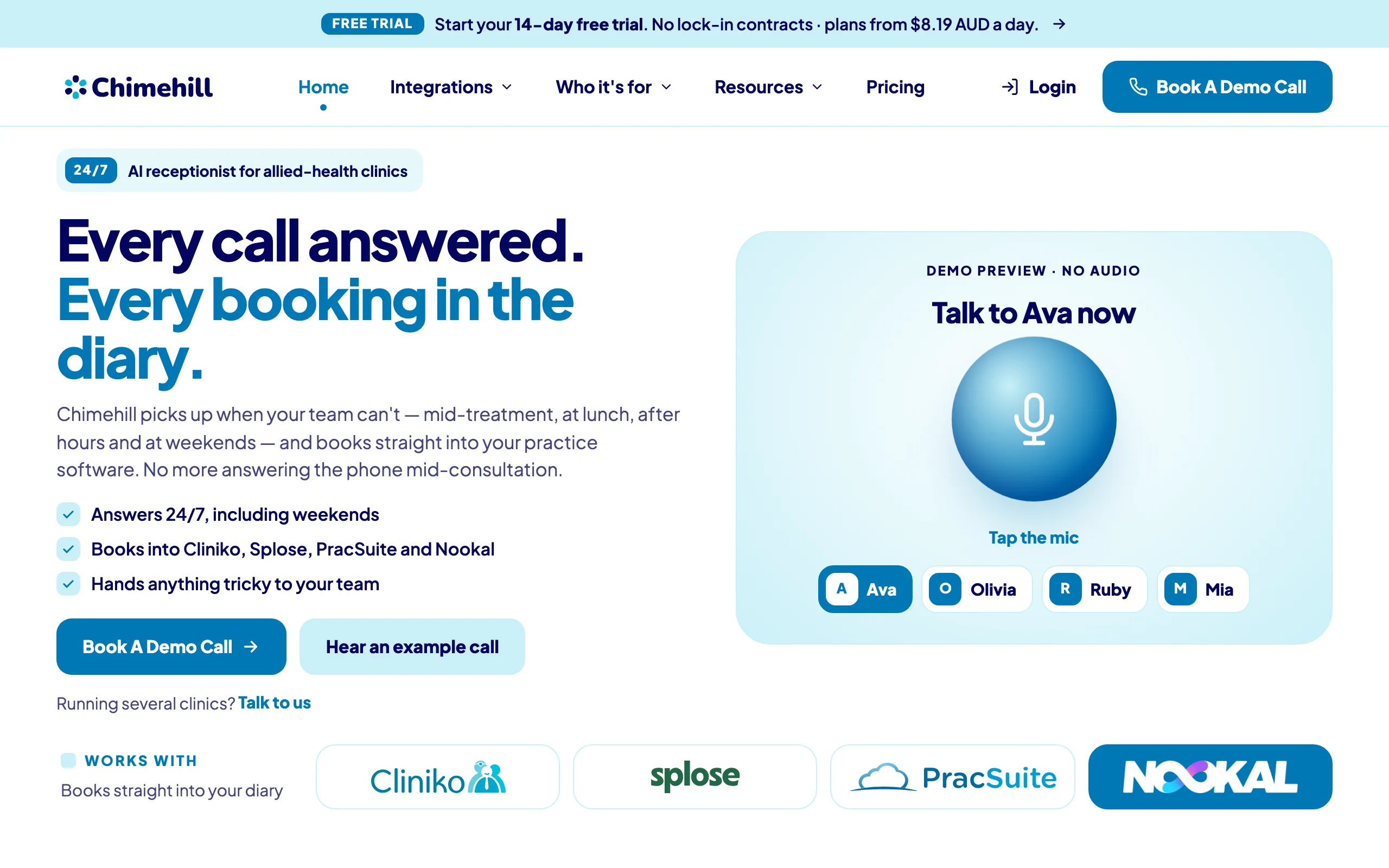
Now the limit. Chimehill's live booking works with Cliniko, Splose, PracSuite and Nookal, which are allied-health systems, not dental ones. It can't open a Dentally, Software of Excellence, Pearl, Dental4Windows or Core Practice diary. So when someone rings for a hygiene appointment or a new-patient exam, Chimehill takes their name, number and what they want, and your receptionist books it in the morning.
Where it earns its place is the rest of the call. It answers from facts your practice signs off: whether you're taking new NHS or private patients, what to bring to a first visit, parking, the deposit or late-cancellation rule. If a fact isn't in its notes, it says so rather than guess, so it won't quote a fee for a crown or offer a slot it can't see. Ask for a person and the call goes to your team, or a callback task lands in the queue, whichever you've set. It never gives clinical advice. When a caller mentions swelling, bleeding after an extraction or a knocked-out tooth, it follows the out-of-hours script your dentists have written. Each call ends up in a log with a summary and an outcome, and a morning summary shows the desk what came in overnight.
Key features
- Day and night cover, weekends and bank or public holidays included, on the number patients already use
- Answers only from facts your practice approves; a person or a callback whenever the caller asks
- Your own urgent-call script for dental pain, swelling and trauma
- A summary and outcome for each call, plus a morning roundup
- Tells callers it's the practice's virtual receptionist
Pricing (as of October 2026)
- Up to 100 calls: £129 / A$249 / NZ$249 a month
- Up to 200 calls: £189 / A$379 / NZ$379 a month
- Up to 350 calls: £289 / A$579 / NZ$579 a month
- Calls over your plan: £1.60 / A$2.70 / NZ$2.70 each
- UK prices are before VAT; Australian and NZ prices are before GST
- 14-day free trial; no lock-in
American readers: there's no US-dollar plan. Converted at the European Central Bank's reference rate for 16 October 2026 (1 AUD = 0.69588 USD), the Australian prices work out to roughly US$173, US$264 and US$403 a month, a guide rather than a quote. Plan details are on the pricing page.
Pros
- Priced per call, so a long call from an anxious first-timer asking about sedation costs the same as a quick one about parking
- Prices on the site in pounds, Australian and NZ dollars, with a trial and no minimum term
- Won't invent fees or appointment times, and hands over to a person on request
Cons
- No booking into dental software; your team still books every appointment
- English only
If you want to hear it handle a toothache call in your practice's name, book a demo.
2. Frontdesk (My AI Front Desk): best cheap AI for American offices running Dentrix, Eaglesoft or Open Dental
Frontdesk is an AI receptionist sold by AI Front Desk, Inc., part of Bevado. It serves all sorts of small businesses, but its dental page goes further than most: it says the AI books appointments live in Dentrix, Eaglesoft and Open Dental, and it lists Curve and Practice-Web as integrations too. If your office runs one of those three, no cheaper option on this list puts the booking in your schedule while the caller is still on the line.
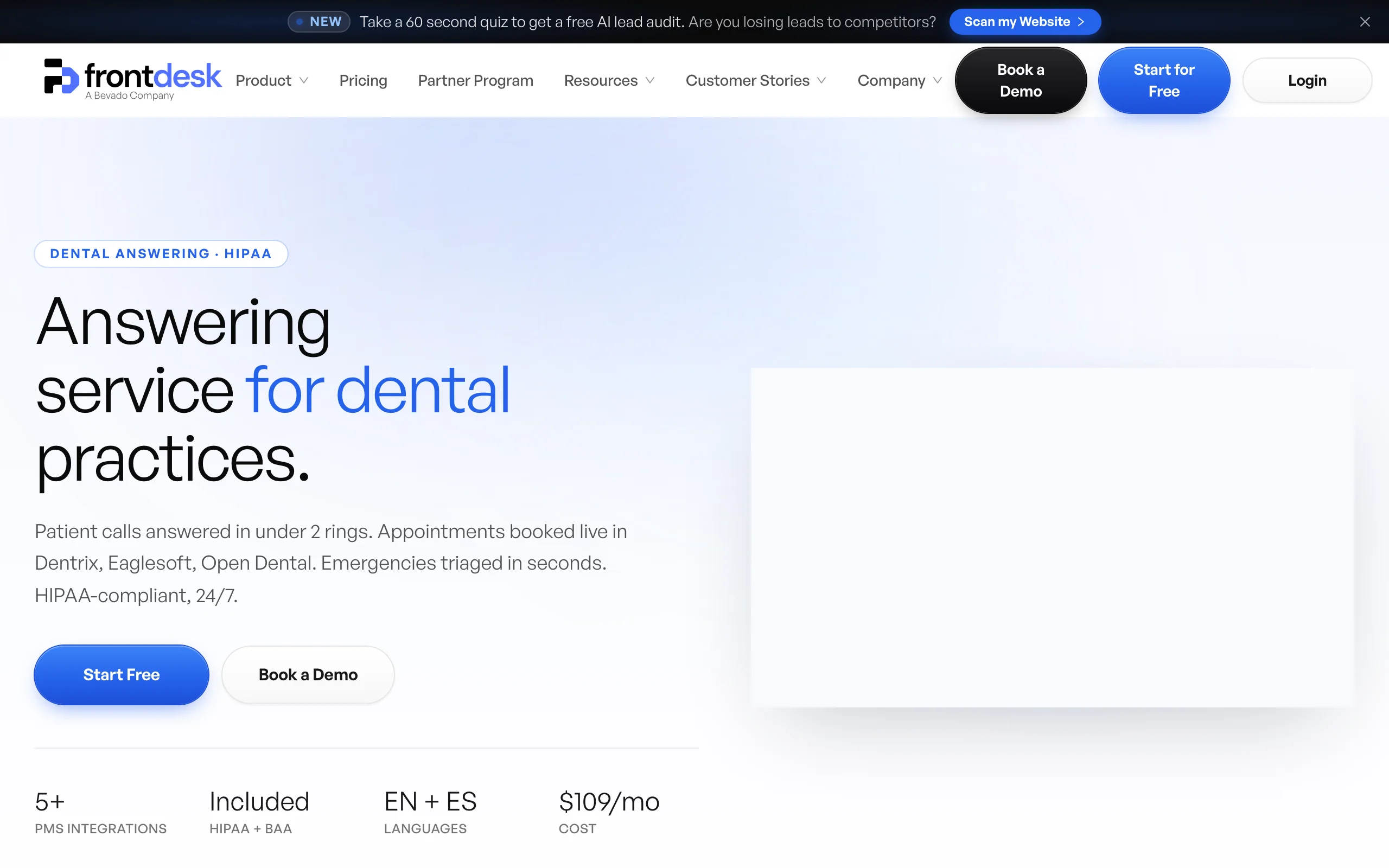
On urgent calls, the dental page says the AI picks up on words like pain, swelling or a broken tooth and sends the caller straight to your emergency line. Other calls that need staff are warm-transferred, or the team gets an alert with the transcript. Frontdesk sells numbers in the US, Canada, the UK and Australia, but every dental system it names is sold in North America, so a UK or Australian practice would get the phone answering without the booking.
Key features
- Books live in Dentrix, Eaglesoft and Open Dental, per its dental page
- Pain, swelling and broken-tooth calls sent to your emergency line
- English and Spanish included on the dental plan
- Warm transfer, or an alert with the call transcript
Pricing (as of October 2026)
- Dental page: US$109 a month flat, 7-day free trial, BAA included
- Pricing page: US$99 a month, or US$79 a month on yearly billing, with 200 voice minutes
- Voice minutes beyond that: US$0.25 each
Pros
- Tells you exactly which American dental systems it can book into
- One of the lowest monthly prices here, with a trial
- HIPAA and a BAA on every plan, the site says
Cons
- Two different prices on its own site; get the one you'll pay in writing
- No UK, Australian or NZ dental software on its dental page as of October 2026
- AI only, with no human receptionists offered
3. Abby Connect: best for American offices that want a person on new-patient and emergency calls and AI on the routine ones, on a single bill
Abby Connect runs a US answering service with receptionists who are all US-based, and sells an AI receptionist on the same plans. The dental page lets you split calls by type: you might keep new-patient enquiries and emergencies with a person and let the AI handle confirmations and "what time do you open?" Change the split whenever you like. Lines are covered 24/7, all year.
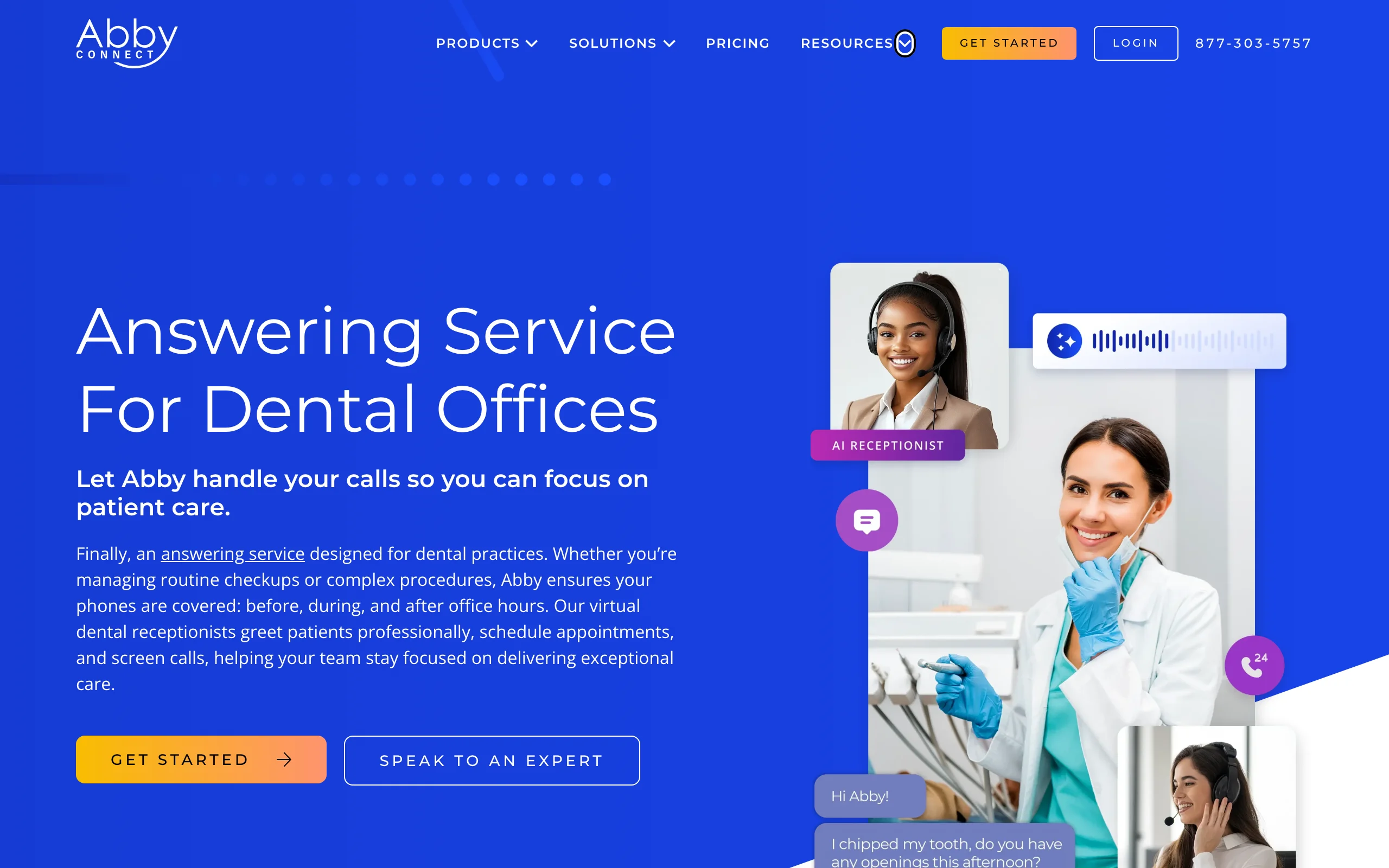
Urgent dental calls go to the dentist on call, Abby says, and everything else is booked or left as a message for the morning team. Billing is in "Abby Minutes": a person's minute costs one and an AI minute costs half. The AI books into calendars and tools such as Google Calendar, Calendly, Dentistry Dashboard and Dengro, and Abby offers to build new integrations at onboarding for free. Dentrix, Eaglesoft and Open Dental aren't on that page, so if those are what you run, ask Abby how the booking will get into your schedule.
Key features
- People or AI, decided per call type
- Urgent calls passed to the dentist on call
- English and Spanish on all plans, no surcharge
- No setup fee and no weekend premium
Pricing (as of October 2026)
- Starter: US$165 a month, 50 Abby Minutes
- Essential: US$329 a month, 100
- Professional: US$599 a month, 200
- Growth: US$1,380 a month, 500
- Monthly terms and a free trial on all plans; overage at your plan's per-minute rate
Pros
- A person and an AI from one company, billed together
- Prices on the site and no contract
- A named route to the on-call dentist
Cons
- The pricing page shows HIPAA options for human answering only; ask how calls the AI takes are covered
- The big US dental systems aren't named, so confirm yours first
- Written for US offices; no other country is mentioned
4. Mango Voice: best for American offices ready to change phone system, with an AI called Margo that leaves callback tasks in the practice software
Mango Voice isn't an answering service you bolt onto your current phones. It's a phone system built for dental offices, and its AI receptionist, Margo, is only sold to Mango customers. That's the trade: you move your lines to Mango, and in return the phones and the AI both talk to your practice software. The dental page lists more than 40 integrations, Dentrix, Eaglesoft, Open Dental, Denticon, Curve and Dentrix Ascend among them.
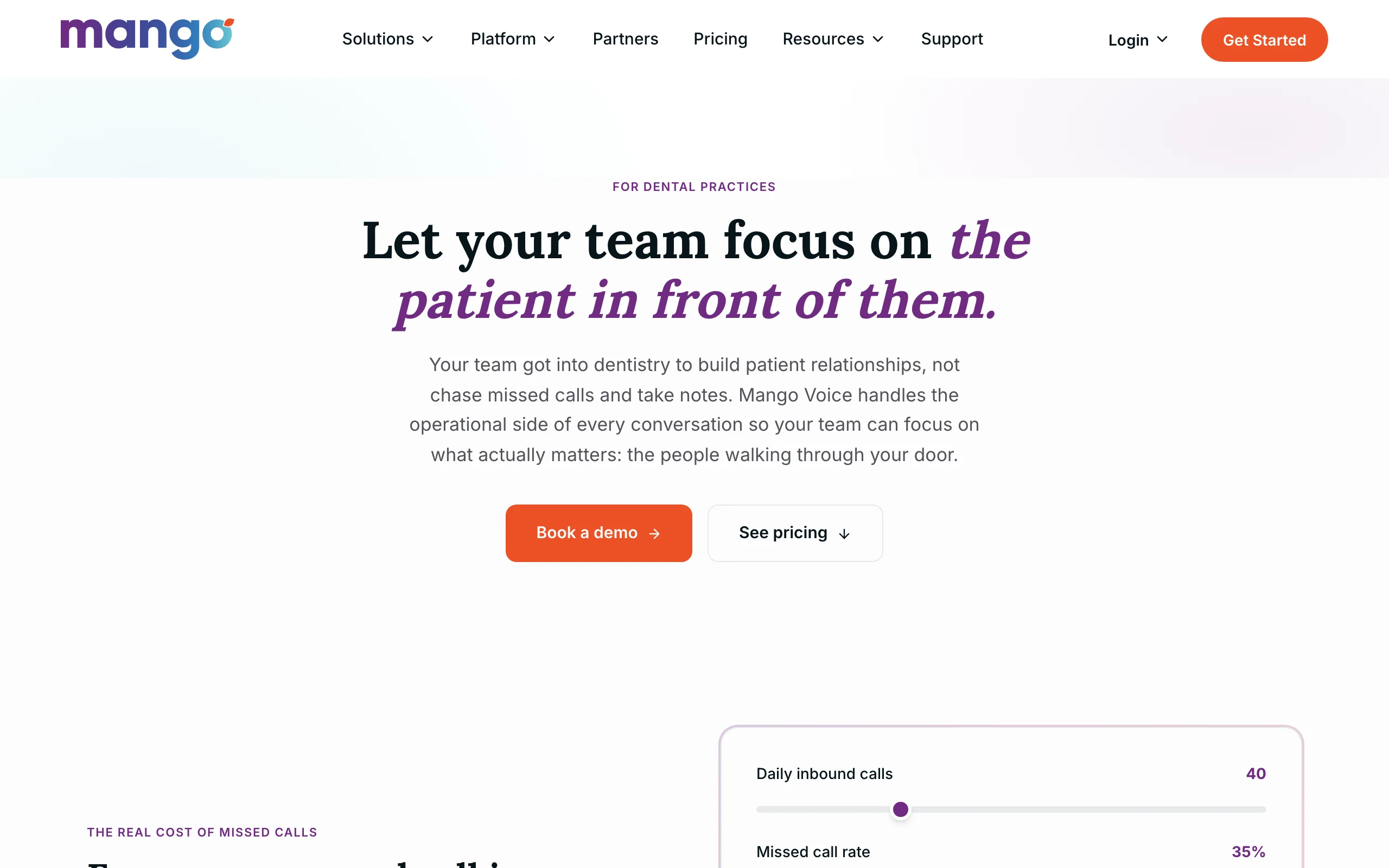
Margo answers when the desk is on another line, at lunch, or after close. It takes the caller's name, the reason for the call and a callback number, then creates a callback task directly in your practice management system for the team to work through. Mango is clear that Margo backs up your staff rather than replacing them, and the page doesn't say Margo books appointments itself. It speaks 13 or more languages. The page doesn't describe an emergency protocol or mention a BAA for Margo, so ask about both on the demo.
Key features
- An AI that answers 24/7 on the Complete plan
- Callback tasks written into your practice software
- Caller ID pop-up from the practice software on the Voice plan and up
- Texting, secure fax and call recording included in every plan
Pricing (as of October 2026)
- Voice: US$249 a month (phone system, texting, fax, recording)
- Voice + AI: US$349 a month (adds AI transcription, summaries and automatic write-back to the practice software)
- Complete: US$449 a month (adds Margo, 24/7 cover and 13+ languages)
- The page doesn't say whether prices are per location or how many users are included; no trial is mentioned
Pros
- Built for dental offices, with the longest list of dental software here
- Missed calls turn into tasks inside the system your team already works in
- One supplier for phones, texts, fax and the AI
Cons
- Margo needs Mango's phone system, so this means switching phone provider
- Margo takes the details for a callback; it doesn't book the appointment
- No emergency routing, BAA or countries outside the US described on its dental page as of October 2026
5. Specialty Answering Service: best for American offices that want live operators at the lowest published price, charged by the second
Specialty Answering Service (SAS) is a US operator service with its own dental page. Operators answer around the clock, take emergency calls and book appointments in your calendar, or in one SAS sets up for you. It calls itself a HIPAA compliant answering service.
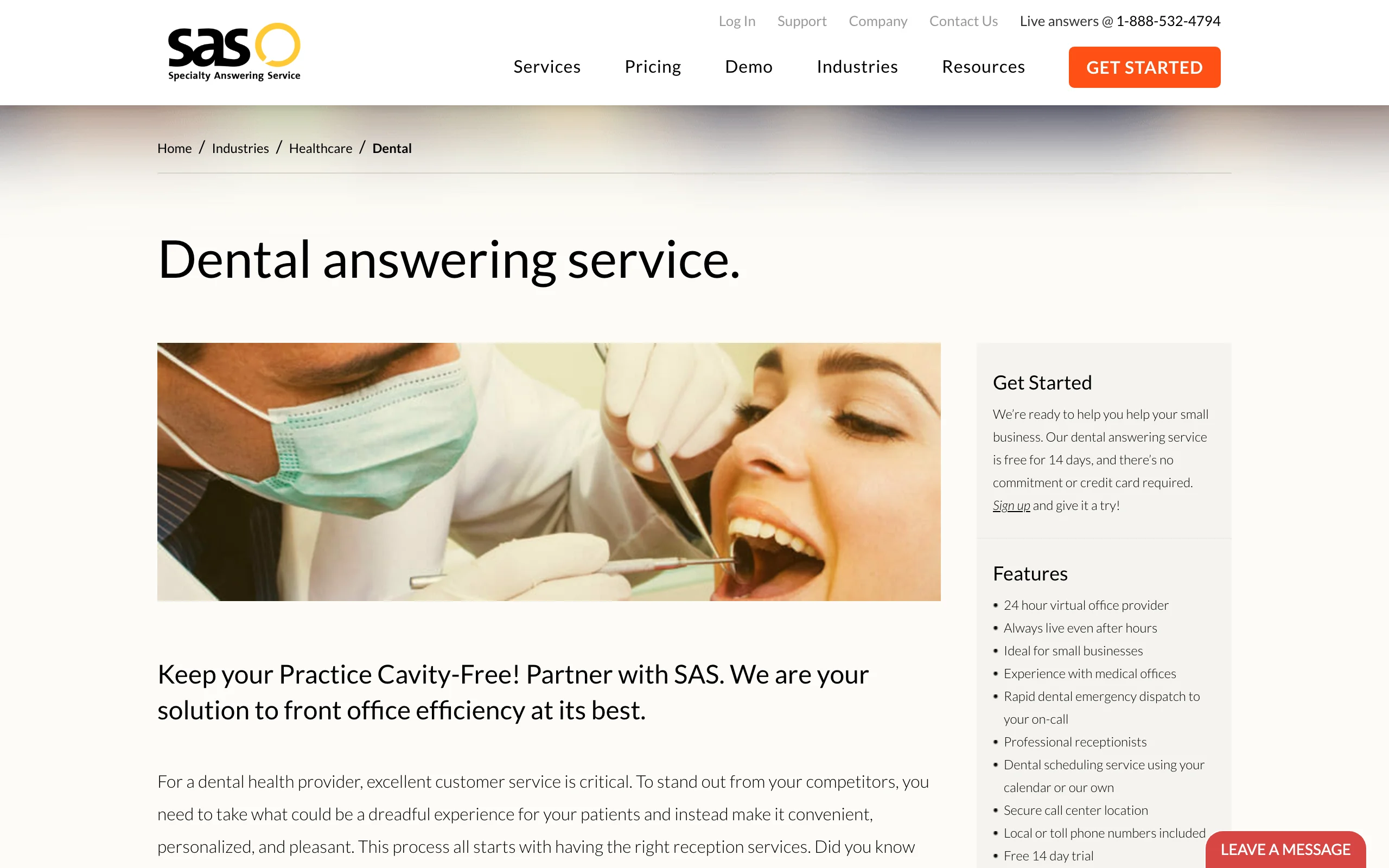
Price is why people shortlist it. Of the people-staffed services here, SAS has the lowest entry price on its site, and it charges by the second, which helps a dental office whose calls are mostly short (confirming tomorrow's 9am, asking if the practice is open on Saturday). Before comparing it, ask what the holiday, weekend, line, toll-free and local-number fees come to: they're listed on the pricing page with no amounts.
Key features
- Operators 24/7, including emergency calls
- Scheduling and appointment reminders
- Per-second billing
- No setup fee, no long-term contract
Pricing (as of October 2026)
- Economy: US$44 a month (minutes included not stated), then US$1.54 a minute
- US$159 a month for 100 minutes (US$1.44 a minute after that)
- US$269 a month for 220 minutes (US$1.44 after)
- US$649 a month for 500 minutes (US$1.34 after)
- Plans go up to 10,000 minutes; 14-day free trial (two weeks or 200 minutes) with no card
Pros
- The lowest published starting price for people answering, and per-second billing
- Trial without a card, no contract
- A dental page that covers emergency calls
Cons
- Weekend, holiday and number fees listed without prices
- Economy plan minutes not stated
- No dental software named
6. FFB: best for UK dental practices that want British receptionists covering weekday evenings and both weekend days
FFB is a British answering service with a page written for dental practices across the UK. It answers calls, books appointments and runs live chat on your website, and every receptionist on its dental service is UK-based. It's the only service here built around UK dentistry rather than adapted from an American offer.
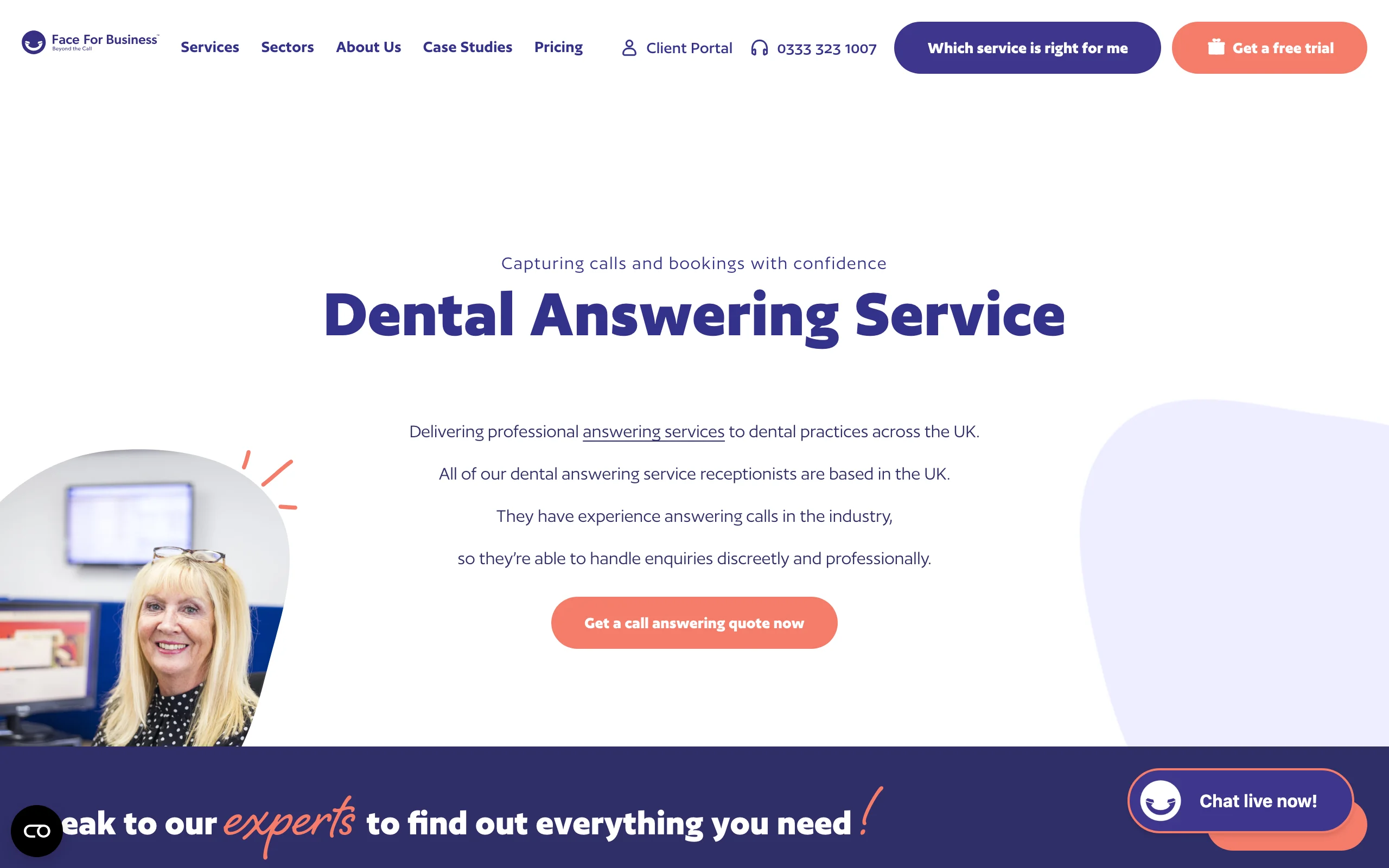
The dental page gives its hours as 8am to 8pm Monday to Friday, 9am to 5.30pm Saturday and 10am to 4pm Sunday. Inside those hours it books patients in and deals with urgent queries once your practice has shut. Through the night, though, no one answers, so a 2am abscess call still needs another plan, such as a message pointing callers to NHS 111 or your own on-call arrangement. FFB can also take payments by phone through Stripe, handy for deposits on private appointments.
Key features
- UK-based receptionists on a dental service
- Evenings on weekdays, plus Saturday and Sunday
- Bookings and urgent queries handled after you close
- Card payments over the phone via Stripe
- Live chat staffed for your website
Pricing (as of October 2026)
- Most popular package: "around £200 a month" (VAT basis not stated)
- 7-day free trial, no obligation
- No long-term contract; cancel before the next monthly invoice
Pros
- Built for UK dental practices, with UK receptionists
- Covers evenings and weekends, when many practices are shut
- A ballpark price and a trial
Cons
- Not 24/7 on the published hours
- The price is approximate, and no dental software is named
7. Moneypenny: best for UK practices that want an AI first, with Moneypenny's own healthcare receptionists behind it
Moneypenny is a British answering company with a healthcare team that works for GPs, care homes and dentists, and it has published a dental case study. You can buy its UK receptionists, its AI receptionist, or the two together. The AI books appointments, routes calls and answers routine questions, then passes the caller to a Moneypenny receptionist (24/7) or to your own staff.
For a dental practice, the appeal is a person behind the AI when a patient is upset or the question is odd. Standard healthcare cover is 8.30am to 6pm, with evenings, weekends or full 24/7 on request, and the healthcare page says appointments can go straight into your system. The integrations it actually names are HubSpot, Salesforce, Calendly, Microsoft Teams and Dynamics 365. Dentally, SOE and Pearl aren't among them, so ask for a demo booking in yours.
Key features
- UK-based healthcare receptionists, 24/7 cover on request
- AI receptionist that hands over to Moneypenny's people or yours
- Bookings made in your system
- Free trial
Pricing (as of October 2026)
- AI receptionist: "from £49 a month" on its AI page, which also says pricing is built around what you need (VAT basis not stated)
- Healthcare answering: quoted on usage
- Schemes of 150 minutes or chats and under: three-month minimum, one month's notice
- Bigger schemes: six or twelve months, three months' notice
Pros
- AI and people from one UK company
- Dentists named among its healthcare clients
- A trial before signing
Cons
- Only a "from" price for the AI; the healthcare service needs a quote
- Contracts of three to twelve months
- No dental software named
How to choose a dental answering service
Three things narrow this list fast: the software your diary lives in, the country you practise in, and the hours you're losing calls.
Can it reach your dental diary?
A service that books into your own software saves your team the most work, and one that books into a separate calendar can create double entries. On the pages we read, Frontdesk is the only one that says it books live into named dental systems (Dentrix, Eaglesoft, Open Dental). Mango Voice links to more dental software than anyone here but leaves a callback task rather than a booking. Nobody named Dentally, Software of Excellence, Pearl, Dental4Windows or Core Practice.
- American office on Dentrix, Eaglesoft or Open Dental that wants bookings made on the call: trial Frontdesk and watch a test booking appear in your schedule.
- American office happy for the team to book, and open to new phones: look at Mango Voice.
- Practice on UK, Australian or NZ software: choose a service that leaves your receptionists a clean list to book from in the morning. In the UK that's Chimehill, FFB or Moneypenny; in Australia and New Zealand, Chimehill.
When do your missed calls happen?
Check a fortnight of call logs from your phone system and look for the bunches: first thing, over lunch, and after 5pm when patients who work ring about appointments. If that's where the gaps are, evening and weekend cover like FFB's may do. If calls also come in late at night and on Sunday, look at the services that run 24/7: Chimehill, Frontdesk, Abby Connect, Mango Voice on its Complete plan and Specialty Answering Service, plus Moneypenny on request. Our 24/7 answering service guide explains how overnight cover is usually set up.
Who handles the toothache at 9pm?
An abscess, a knocked-out tooth or bleeding that won't stop after an extraction will come in at some point, and whoever answers isn't a dentist. Your dentists decide what counts as urgent and what the caller is told. In the demo, play a patient whose face is swelling and watch what happens: who is phoned, what the patient hears, and whose wording that is. Abby Connect passes urgent calls to the dentist on call, Frontdesk sends them to your emergency line, and Chimehill reads the script your dentists approved. Mango Voice and FFB don't describe an emergency route in detail on their dental pages, so ask.
A person, an AI or both?
A nervous patient, or one in pain, can do better with a person. An AI picks up on the first ring at 11pm and costs less per call. Abby Connect and Moneypenny sell both, so you can keep the hard calls with people. Our comparison of a clinic answering service and an AI receptionist covers how the two differ.
What will a typical month cost?
The services charge in different ways: by the minute (Abby Connect, Specialty Answering Service, Frontdesk), by the call (Chimehill), a flat monthly plan that also replaces your phone bill (Mango Voice), and quotes (Moneypenny's healthcare service). FFB gives a ballpark and Moneypenny's AI has a "from" price. Per included minute, as of October 2026, Abby Connect works out at about US$2.76 to US$3.30, Specialty Answering Service about US$1.22 to US$1.59 on the 100- to 500-minute plans, and Frontdesk about US$0.50 an AI minute. Chimehill's included calls come to about A$1.65 to A$2.49 each, long or short.
The only fair test is your own volume. Take one month of calls and the average call length, and price every plan against that month. For a practice with 150 calls a month averaging three minutes (450 minutes), using published prices as of October 2026 and leaving out weekend, holiday or number fees:
- Abby Connect, people on every call: Growth plan, US$1,380. With the AI on every call, 450 minutes count as 225 Abby Minutes: Professional plus 25 extra, about US$674
- Mango Voice: Complete plan, US$449, which also covers the phone system, texting and fax
- Specialty Answering Service: 220-minute plan plus 230 minutes at US$1.44, about US$600
- Frontdesk: the US$99 plan plus 250 AI minutes at US$0.25, about US$162
- Chimehill: the 200-call plan, £189, A$379 or NZ$379 (about US$264)
Cheapest isn't automatically right. Paying for a person on every call costs several times what an AI does, and whether your patients need that is your call.
Does it fit your country's rules?
Four of the seven are American, and their privacy promises are about HIPAA. That matters to a US office, but a UK practice works under UK GDPR, an Australian one under the Privacy Act 1988, and a New Zealand one under the Privacy Act 2020 and its Health Information Privacy Code. Patients ringing a dental practice give names, dates of birth and details about their teeth, which is health information in all three. Ask each provider where recordings and transcripts are kept, for how long, and who can play them back. Ask us as well: Chimehill hasn't yet published its hosting region or retention period.
Australian and New Zealand practices have fewer choices here. Chimehill is the only one of the seven with prices in Australian or NZ dollars. Frontdesk sells Australian numbers, but the dental systems it books into are all North American.
Before you sign
- The real monthly figure at your call volume, with weekend, holiday and number fees
- Minimum term and notice
- A booking or callback task appearing in your dental software, live, during the demo
- The emergency script, and who can edit it
- What the team gets after each call, and how quickly
Then go slowly. Send only after-hours or lunchtime overflow calls for the first two weeks, listen to a handful of recordings, and check the morning list against what patients actually asked for.
Questions dental practices ask
What does a dental answering service do?
It picks up the practice phone when your receptionists can't: during a busy check-in, at lunch, after close or at weekends. Depending on the service, it takes messages, answers questions about hours and new patients, books or requests appointments, and passes dental emergencies to whoever is on call. List the calls you lose most (recall bookings, new patients, emergencies) and pick the service that handles those.
How much does a dental answering service cost?
As of October 2026, published prices here start at US$44 a month (Specialty Answering Service, plus per-minute charges). For about 450 minutes a month, our worked example ranges from about US$162 for AI to US$1,380 for people on every call. Chimehill is £129, A$249 or NZ$249 a month for up to 100 calls. Price against your own call log, not the headline.
Can an answering service book straight into Dentrix, Eaglesoft or Open Dental?
Of these seven, only Frontdesk says on its dental page, as of October 2026, that it books live into them. Mango Voice connects to all three but creates a callback task rather than a booking. The rest use a calendar or "your system" without naming dental software. Ask to see a test booking in your own system.
Is there a dental answering service for UK practices on Dentally or Software of Excellence?
None of the services we checked named Dentally or Software of Excellence. FFB and Moneypenny are UK-based and book appointments but don't say which systems they use; Chimehill takes the details for your team to book. Ask any provider to show a booking in your software before you sign.
Can an answering service handle dental emergencies?
It can pass them on; it can't assess them. A sound set-up spots urgent calls and follows the script your dentists wrote, for example transferring to the dentist on call or giving your out-of-hours instructions (in the UK, often NHS 111). Make a test emergency call during the trial.
Can Chimehill put appointments in a dental practice's software?
No. Chimehill books only into Cliniko, Splose, PracSuite and Nookal, none of which is dental software. For a dental practice it answers, gives your approved answers, takes the request and passes it to your team to book. See the integrations page for the full list.
Should patients be told an AI answered the practice phone?
They should be told. Saying it up front, and putting callers through to a person whenever they ask, is what keeps patients comfortable. Chimehill introduces itself as your practice's virtual receptionist; ask any AI provider for its exact greeting.