

A physio's phone tends to ring at the worst moment: halfway through a knee assessment, or at 7pm when someone has finally got home with a sore back. If you work alone, nobody picks up. A caller with a new injury who rings off usually tries the next clinic on the list, taking a whole course of treatment with them. Those are the calls the best AI receptionist for physiotherapy has to catch.
Answering is the easy part. A good one books a new injury as an initial assessment, keeps a follow-up with the treating physio, passes exercise questions and WorkCover, ACC or insurer claims to your team, and writes into the practice software you already use.
Seven tools are compared below on those points: six answer with AI and one puts a person on every call. Prices, plans and integration lists come from each vendor's own site, checked on 15 and 16 October 2026. Mixed allied-health practice? The AI receptionists for clinics roundup is the wider list.
Best AI receptionists for physiotherapy: a quick overview
- Chimehill: best for physios whose diary lives in Cliniko, Splose, PracSuite or Nookal and who want a new injury booked as an initial assessment before the caller hangs up.
- Trillet: best for Australian clinics that want call recordings and transcripts kept in Australia.
- Moneypenny: best for UK physios with insurer-funded patients who want a UK receptionist to take over from the AI.
- Frontdesk (My AI Front Desk): best for physical therapy practices on WebPT or Jane App.
- Dialzara: best for sole practitioners who want a cheap first try of AI answering.
- Ruby: best for US and Canadian physical therapy practices whose patients would rather speak to a person.
- Goodcall: best for US physical therapy practices whose patients ring several times during a course of treatment.
| Tool | Best for | Books into physio practice software? | Price (as of October 2026) |
|---|---|---|---|
| Chimehill | AU, UK and NZ physios booking assessments during the call | Yes: Cliniko, Splose, PracSuite and Nookal | A$249, £129 or NZ$249 a month for 100 calls, plus GST or VAT (roughly US$172) |
| Trillet | Recordings kept onshore in Australia | Cliniko and Halaxy appear on its health page, not its integrations page | 49 dollars a month for 150 minutes; no currency given |
| Moneypenny | UK clinics with insurer-funded patients | Promises booking "directly into your system"; names no physio software | AI from £49 a month; healthcare answering priced on request |
| Frontdesk | US practices on WebPT or Jane App | WebPT, Jane App, NetHealth, ClinicSource and more | US$99 a month, or US$79 a month paid yearly |
| Dialzara | Testing AI on a sole practitioner's line | Google Calendar or Outlook, not a patient diary | US$29 a month for 60 minutes and up |
| Ruby | US and Canadian patients who want a person | None named | US$250 a month for 50 minutes and up |
| Goodcall | US patients who ring several times a month | Google Calendar | US$79 a month for 100 unique callers and up |
1. Chimehill: best for physio clinics on Cliniko, Splose, PracSuite or Nookal
Chimehill answers the phone for independent allied-health clinics in Australia, the UK and New Zealand, and it has a set-up made for physiotherapy. It's an AI receptionist: while you're hands-on with a patient, at lunch, or closed for the evening or weekend, it takes the call, books or moves the appointment in your practice software, gives the answers you've signed off on and leaves your team a summary of whatever it can't handle.
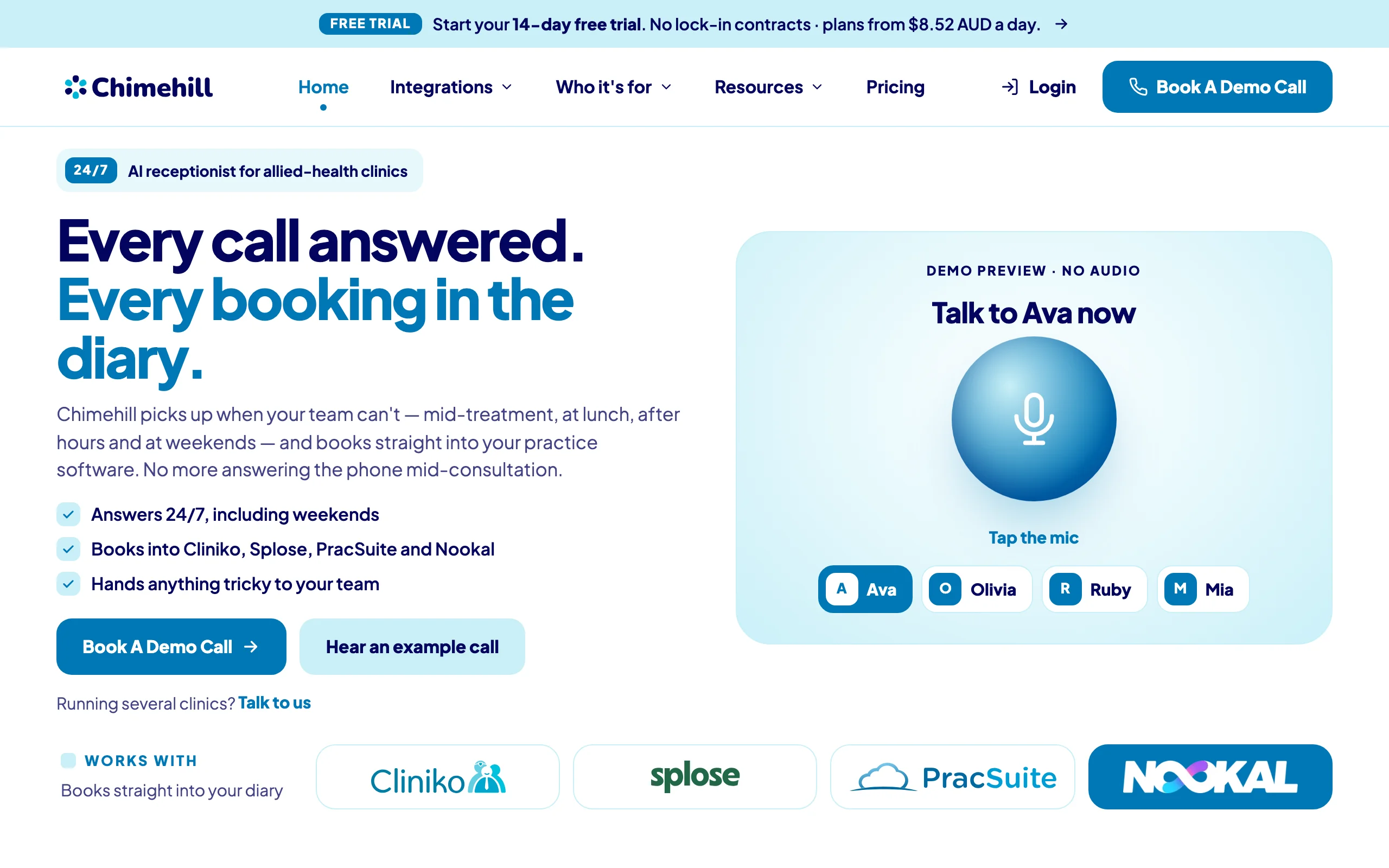
What makes it fit a physio diary is appointment types. Someone who rolled an ankle at Saturday netball and rings on Sunday night gets your initial-assessment slot, the longer one, not a short follow-up that leaves you running late. A patient three sessions into rehab is identified first, then offered times with the physio who has been treating them, or with a colleague if your clinic allows that. Questions about pain, injuries or exercises go to your physios, and calls about health funds, Medicare care plans, WorkCover or third-party claims become a callback task for the front desk. Sample calls, including a WorkCover question that comes in on a Saturday, are on the physiotherapy page.
Key features
- Writes bookings into Cliniko, Splose, PracSuite or Nookal from slots that are actually free, and checks the slot again a moment before saving
- Initial assessments booked as the longer appointment type; follow-ups kept with the treating physio
- Only says "you're booked" once your software has accepted the booking; if the save fails, the caller is told it isn't confirmed and the clinic rings back
- Asks for name and date of birth before it opens or changes anyone's booking, because a familiar number doesn't prove who is calling
- Quotes your cancellation notice when a patient moves or cancels a session
- No assessment, pain or exercise advice; urgent language sets off an escalation script your physios have approved
Pricing (as of October 2026, GST or VAT on top)
| Plan | Australia | New Zealand | UK | Rough US$ estimate |
|---|---|---|---|---|
| 100 calls a month | A$249 | NZ$249 | £129 | US$172 (estimate) |
| 200 calls a month | A$379 | NZ$379 | £189 | US$262 (estimate) |
| 350 calls a month | A$579 | NZ$579 | £289 | US$400 (estimate) |
| Per call over the plan | A$2.70 | NZ$2.70 | £1.60 | US$1.87 (estimate) |
Chimehill sets its prices in Australian dollars, New Zealand dollars and pounds. The US figures are our own conversion from the Australian price, at the European Central Bank reference rate of 1 AUD = 0.691 USD on 15 October 2026. Any plan comes with 14 days free, and there's no contract to break if you leave. Plan inclusions are on the pricing page.
Pros
- Built around Cliniko, Splose, PracSuite and Nookal
- Knows the difference between an initial assessment and a follow-up
- Billed per call, so a long new-injury call costs no more than a quick follow-up reschedule
Cons
- Only four practice systems are supported, so physios on Jane App, Halaxy, Power Diary, WebPT or similar can't have it book for them yet
- Answers in English only, and it hasn't published where call data is hosted; ask before signing if onshore storage matters to you
To hear it take a new-injury call in your clinic's name, book a demo.
2. Trillet: best for Australian clinics that want call recordings and transcripts kept in Australia
Trillet is Australian-owned and builds voice AI agents for regulated work, with healthcare, legal and financial services among its markets. Its healthcare page says the agent can book, reschedule or cancel appointments "against your live schedule", take intake details before a visit, check insurance cover and send reminders. It also offers Australian data residency for call recordings, transcripts and backups, which is a question many Australian practice owners ask first.
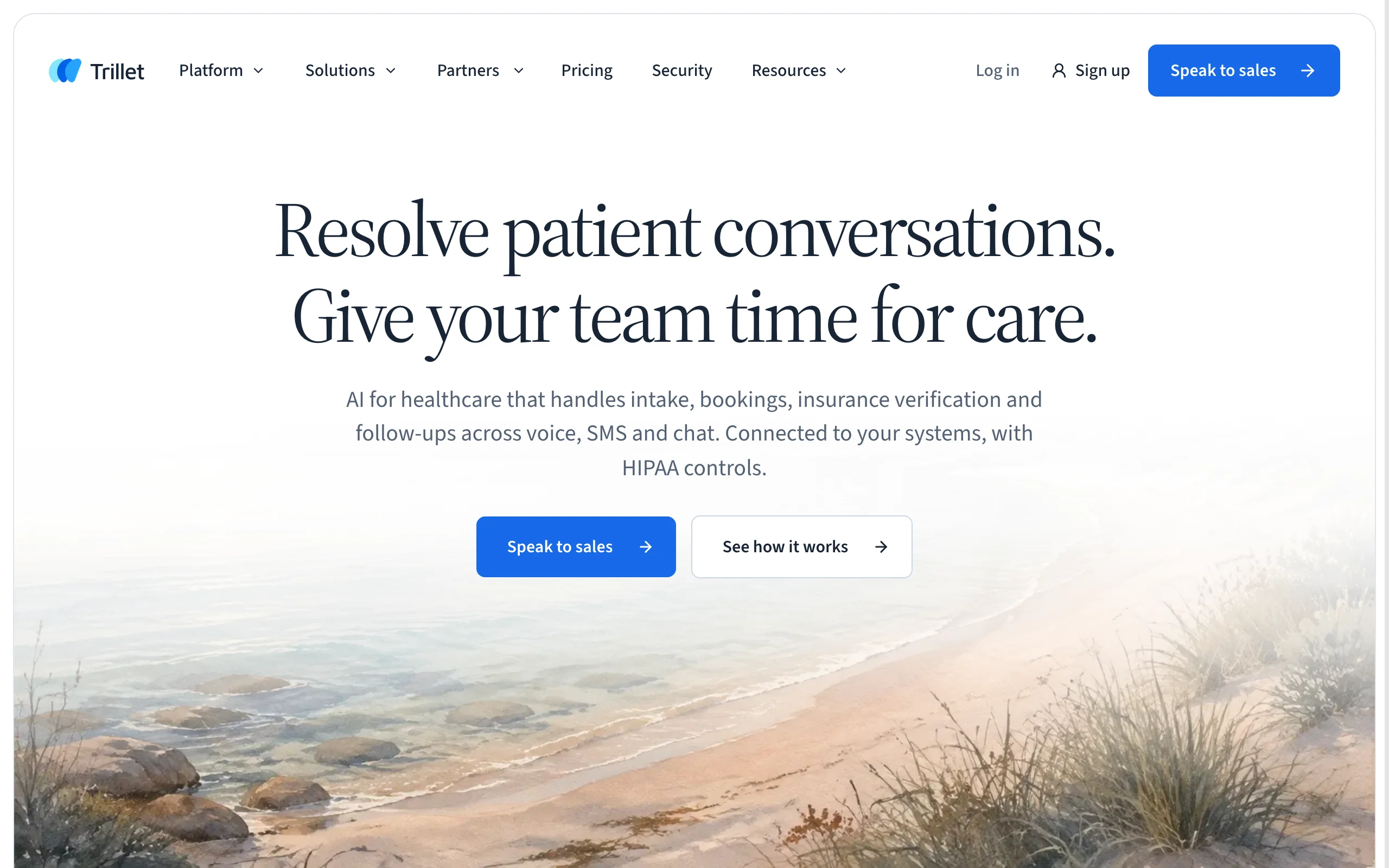
On clinical boundaries the same page is specific: the agent "does not assess symptoms or give clinical advice", the AI never triages a medical emergency, and anything that needs clinical judgement goes to staff with the context attached. That's the right line for a "should I keep doing these exercises?" call. It names Cliniko and Halaxy among the Australian systems it works with. Its integrations page, though, lists only ServiceTitan, GoHighLevel, Google Calendar and a custom API option, so ask exactly how the Cliniko connection works before you rely on it.
Key features
- Voice, SMS and chat from one agent
- Booking, rescheduling and cancelling, with intake details captured during the call
- Escalation to staff for anything needing clinical judgement
- Option to keep recordings, transcripts and backups in Australia
Pricing (as of October 2026)
- Receptionist plan: 49 dollars a month including 150 minutes, then 20 cents for each extra minute; the pricing page names no currency and says nothing about GST
- Month to month with no set-up fee; instead of a free trial, there's a 28-day money-back guarantee
Pros
- Australian-owned, with in-country storage for recordings and transcripts available
- Clear statements that the AI doesn't assess symptoms or triage emergencies
- Low published entry price
Cons
- The integrations page doesn't list Cliniko or Halaxy, so the type of connection needs confirming
- Currency and tax basis aren't stated on the pricing page
- Per-minute billing, so long new-patient calls use more of the allowance
3. Moneypenny: best for UK physios with insurer-funded patients who want a UK receptionist to take over from the AI
Moneypenny is a British answering company whose healthcare team already takes calls for private clinics, GPs, dentists and care homes. It now sells receptionists, an AI receptionist, or a mix of the two. The AI deals with routine calls such as bookings, opening-hours questions and messages, then passes the caller to a Moneypenny receptionist or to your own staff when it gets stuck or the caller is getting annoyed. Moneypenny says all its receptionists are based in the UK.
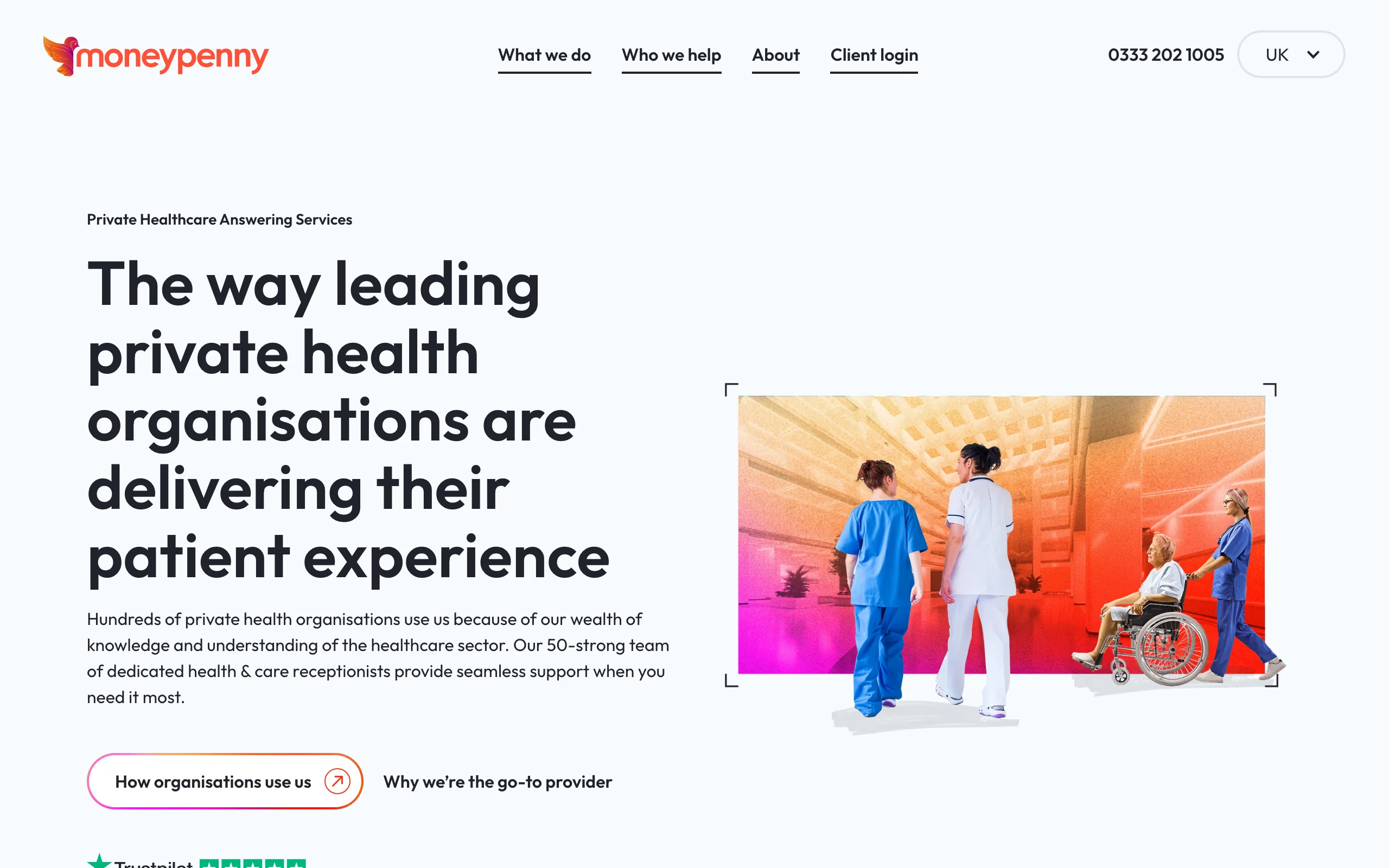
That matters for a UK private physio whose phone gets a steady run of "will my insurer cover my sessions?" calls from Bupa, AXA or Vitality members, where a person can take the policy and authorisation details properly. The weak point for physios is the diary. The healthcare page promises bookings "scheduled directly into your system", yet the tools its AI page actually names are Calendly, HubSpot and Salesforce, none of them physio software.
Key features
- Healthcare receptionists based in the UK, with round-the-clock cover available on request
- AI receptionist with handover to Moneypenny staff or your team
- You decide which call types reach a person
- Core hours 8.30am to 6.00pm, with evenings and weekends available on top
Pricing (as of October 2026)
- AI receptionist: "from £49 a month", with no word on whether that includes VAT
- Healthcare answering service: priced on request, and a free trial is offered
- Answering contracts run for at least three months on smaller schemes and six or twelve on larger ones
Pros
- People and AI from one UK provider
- Private healthcare experience
- Free trial on the answering service
Cons
- None of Cliniko, Splose, PracSuite, Nookal or Jane App is named on the pages we checked
- Minimum terms on the answering service
- Built for the UK; its site doesn't cover Australia or New Zealand
4. Frontdesk (My AI Front Desk): best for physical therapy practices on WebPT or Jane App
Frontdesk is made by AI Front Desk, Inc., part of Bevado, and its AI handles calls, texts, web chat and email. Where most general receptionists stop at Google Calendar, it has a whole therapy section, and the physical therapy pages list WebPT, NetHealth, Jane App, ClinicSource, Fusion Web Clinic and PtEverywhere as integrations. It can also run insurance eligibility checks through US clearing houses including Availity and Waystar.
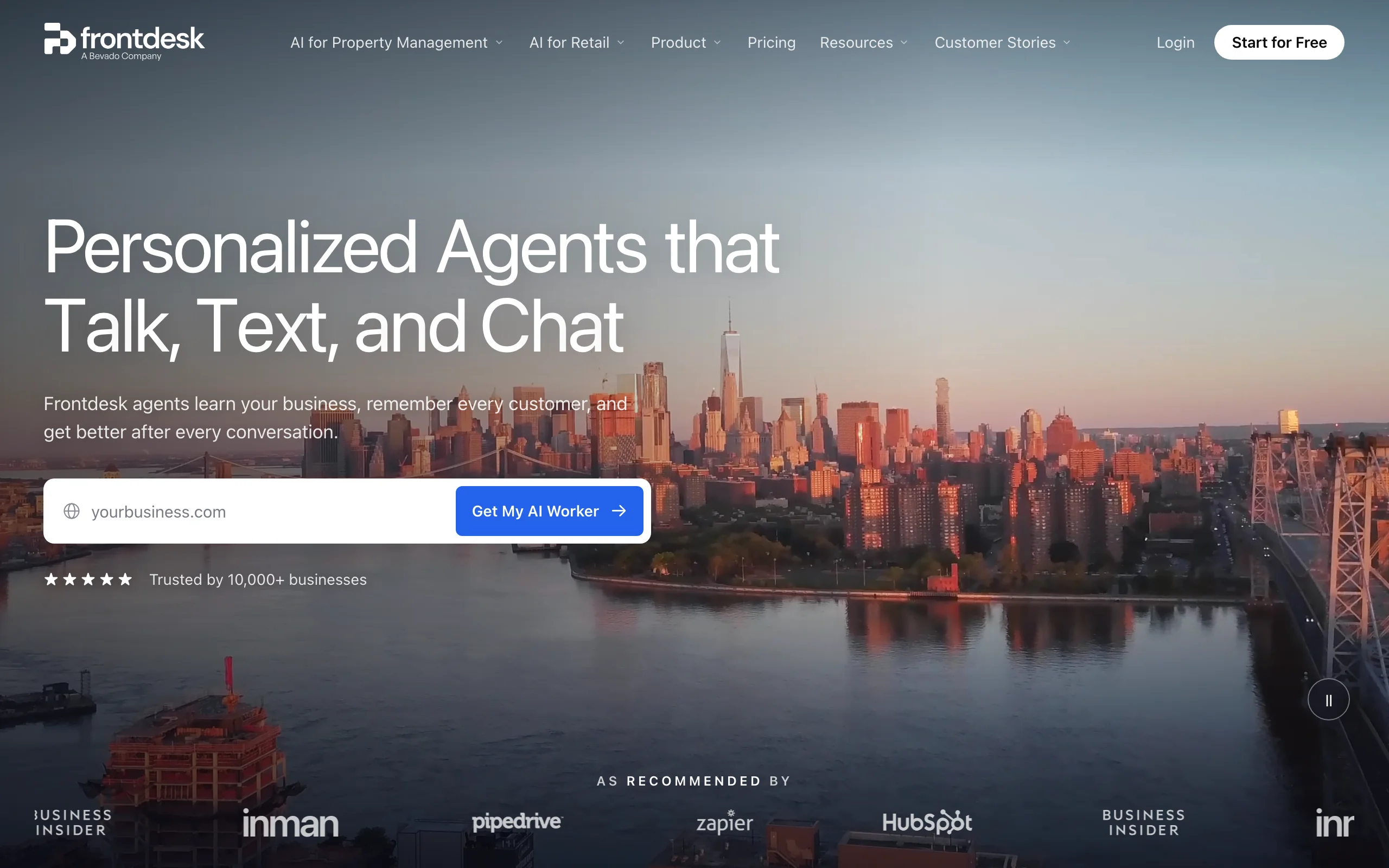
Most of that is aimed at US outpatient physical therapy (direct access, workers' comp intake, Medicare cap tracking). If your clinic outside the US runs on Jane App, that integration is the part to look at. For phone numbers, its own tutorial names the US, Canada, the UK and Australia as the main four countries. International numbers go through a verification step that normally takes two or three business days, so allow for that before you pick a go-live date.
Key features
- Names WebPT and Jane App among its physical therapy integrations
- PT intake covering direct access, workers' comp and Medicare caps (US)
- Hands the call to a person with a warm transfer, or sends your team an instant alert with the transcript
- Over 20 languages on the general pricing page
Pricing (as of October 2026)
- Business-in-a-Box plan: US$99 a month, dropping to US$79 a month if you pay yearly, with 200 voice minutes included
- Minutes past that come out of credits, roughly US$0.25 each
- Seven-day trial; there's no free-forever plan
Pros
- The most physical therapy integrations in this list
- States HIPAA compliance and offers a business associate agreement, which a US practice will ask for
Cons
- No Cliniko, Splose, PracSuite or Nookal on its integration list (checked October 2026), so a clinic on those would be copying bookings across by hand
- The PT workflows (Medicare caps, US eligibility checks) are built around US funding, not WorkCover, ACC or UK insurers
- Credit-based billing takes some working out
5. Dialzara: best for sole practitioners who want a cheap first try of AI answering
Dialzara sells AI call answering to small businesses of every kind. It picks up 24 hours a day, puts bookings into Google Calendar or Outlook, filters out spam calls and emails a summary after each one. Setting it up means forwarding the number you already have. Nothing in it is built for healthcare, and its FAQ tells businesses in regulated fields to speak to its sales team before going live rather than lean on blanket compliance claims.
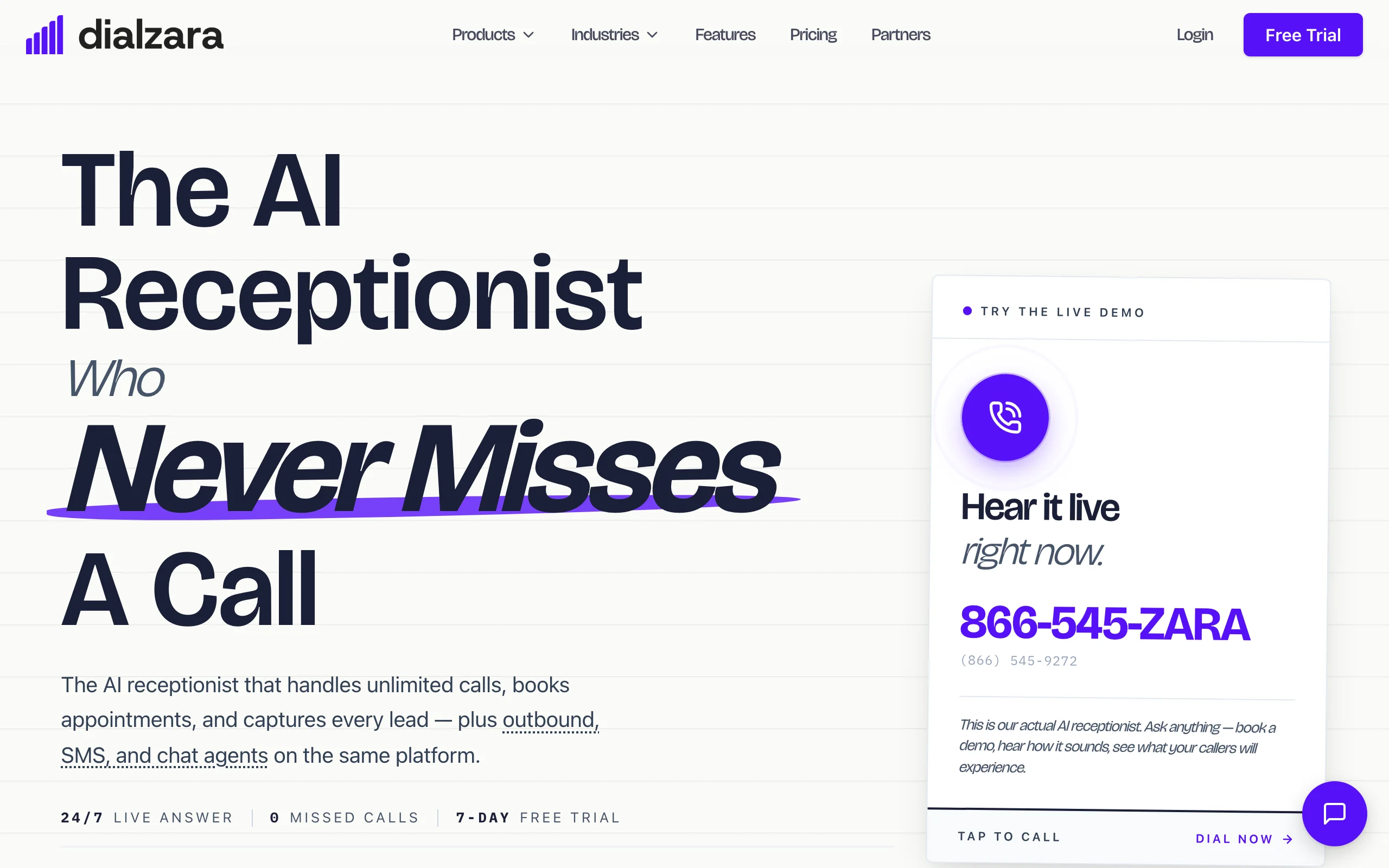
For a physio working alone, the appeal is the entry price: forward your line during sessions for a week and see what you've been missing. Bookings land in a general calendar, not your patient diary, so you'd copy them across between patients.
Key features
- Native Google Calendar and Microsoft Outlook connections
- Different transfer numbers for different kinds of call
- Picks up the caller's language from their first sentence, across the ten it lists
- SMS and chat agents can run on the same platform
Pricing (as of October 2026, USD)
- Business Lite: 60 minutes for US$29 a month, then US$0.48 a minute
- Business Pro: 220 minutes for US$99 a month
- Business Plus: 500 minutes for US$199 a month
- Business Elite: 1,000 minutes for US$349 a month
- Seven-day trial, no set-up fees, cancel when you like
Pros
- Lowest starting price in this list
- Month to month, no set-up fee
Cons
- Books into general calendars, not physio practice software
- Its FAQ only talks about US numbers, so check whether it can give you a local Australian, UK or NZ number
6. Ruby: best for US and Canadian physical therapy practices whose patients would rather speak to a person
Ruby is an American virtual receptionist company where a person answers every call. It uses AI behind the scenes for transcripts and call flows, never to talk to callers. Healthcare is on its list of industries, with doctors, dentists and chiropractors named, and HIPAA-compliant handling costs nothing extra once you've signed a business associate agreement.
That suits a practice whose patients, say people recovering from a joint replacement, would hang up on anything that sounds automated. The catch for most readers of this post: Ruby works only in the United States, Canada and the US Caribbean, so physios in Australia, the UK and New Zealand can't sign up.
Key features
- People answering around the clock, weekends and holidays included
- English and Spanish answering
- Appointment scheduling, intake and outbound calls
- A mobile app for your team
Pricing (as of October 2026)
- 50 minutes: US$250 a month
- 100 minutes: US$395 a month
- 200 minutes: US$720 a month
- 500 minutes: US$1,725 a month
- Charged per 60 seconds with hold time counted; first-time customers get a 21-day money-back guarantee
Pros
- Every caller talks to a person
- No long-term contract
Cons
- Per-minute pricing climbs quickly with long new-patient calls
- No practice software named
- US, Canada and US Caribbean only
7. Goodcall: best for US physical therapy practices whose patients ring several times during a course of treatment
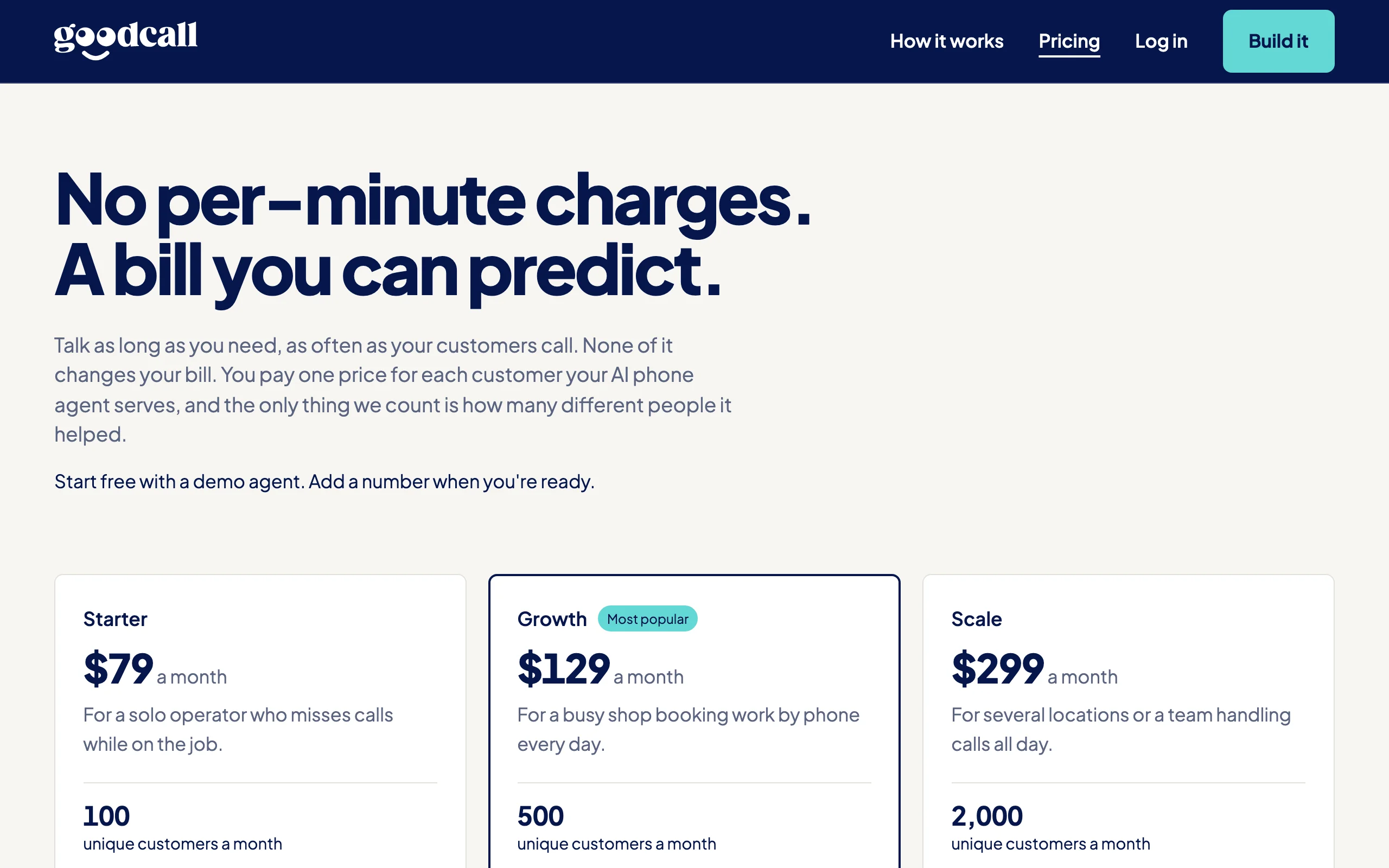
Goodcall bills by how many different people it talks to in a month, rather than by minutes or number of calls. That fits physical therapy well: a patient partway through a course of treatment might ring three times in a month to move sessions, and Goodcall counts them once. An assistant builds the phone agent from your plain-language instructions.
Goodcall's homepage says it is HIPAA and SOC 2 compliant and shows it booking new patients. Bookings go into Google Calendar rather than a patient record system. According to its help centre it only operates in the USA for now, and people elsewhere can join an interest list.
Key features
- Looks up free times in Google Calendar, books, and texts the caller the details
- Routes calls to a named person, with a fallback if they don't answer
- Call recording with transcripts
- Use a new local number or forward your current one
Pricing (as of October 2026)
- Starter: 100 unique callers for US$79 a month, then 79 US cents per extra caller
- Growth: 500 unique callers for US$129 a month
- Scale: 2,000 unique callers for US$299 a month
- Try a demo agent free; payment starts when you connect a number
Pros
- Repeat callers in the same month don't change the bill
- Simple set-up from plain-language instructions
Cons
- US only as of October 2026
- No physical therapy practice software named
How to pick one for a physio clinic
Every demo sounds smooth on a simple booking. Physio calls get awkward in particular ways, so test those on purpose with every vendor.
Does it know an initial assessment from a follow-up?
A new patient with a sore shoulder needs your longer initial-assessment slot. Someone halfway through a course of treatment needs a follow-up, ideally with the physio who's been seeing them. Ask the vendor to show both on a demo call. If it books everyone into the first free 30 minutes, your diary will need fixing every morning.
- On Cliniko, Splose, PracSuite or Nookal and want the assessment in the diary before the caller hangs up? Try Chimehill first.
- If you're in Australia and data location matters most, ask Trillet how it connects to your system.
- If you're a US physical therapy practice on WebPT or Jane App, look at Frontdesk.
Does it pass injury and exercise questions to a physio?
"My knee's sorer since I started the new exercises. Should I keep going?" is a clinical question, even when the caller treats it as a quick one. An AI receptionist should never answer it. The right response is a booking or a call back from a physio, and nothing more. Ring the demo line with that exact question and listen to what happens. Then try urgent language, such as sudden severe pain after a fall, and check that it reads an escalation script your clinicians have approved rather than improvising.
Who handles WorkCover, ACC and insurer calls?
Funded treatment brings its own calls: WorkCover claims and Medicare care plans in Australia, ACC in New Zealand, and private insurers such as Bupa, AXA or Vitality in the UK. Whether a claim covers a session depends on details only your team can check. What the AI can do is repeat admin facts you've written down, such as whether you claim health fund rebates on the spot, and pass everything else to the desk as a callback with the insurer and claim number noted. A good demo question: "I hurt my shoulder at work. Will ACC cover my sessions?" Listen for whether the AI guesses.
Does it suit a sole practitioner?
If you work alone, a transfer to "the team" means a transfer to you, mid-treatment. Check that the tool can finish a booking or take a clear message without a person, and that you can read call summaries on your phone between sessions. Small per-minute allowances run out fast once after-hours calls are added.
Pricing models
Per minute (Trillet, Ruby, Dialzara, Frontdesk) makes long new-patient calls expensive and is hard to forecast. Per call (Chimehill) is simpler, but ask what counts as a call. Per caller (Goodcall) suits patients who ring several times in a month. Quoted pricing (Moneypenny's answering service) needs a written quote. Pull last month's call log, missed calls included, and get each vendor to price that exact month in writing.
Privacy for health information
A physio call summary that mentions an injury holds health information. According to the OAIC, the Privacy Act reaches any health service provider holding health information, small businesses included, so a two-physio practice in Australia is covered. Under UK GDPR, an injury mentioned on a call is special category data. New Zealand physios fall under the Health Information Privacy Code 2020.
A vendor's HIPAA statement only speaks to US law and answers none of those questions. Get written answers on where recordings and transcripts are kept and for how long, which sub-processors handle them, and whether callers hear that they're speaking to an AI.
A two-week trial run
Start with a test diary and your approved answers: prices, parking, what to wear, whether a GP referral is needed. Get one of your physios to read the escalation script. Then make the awkward calls yourself: a new injury at 8pm, a follow-up you want moved but kept with the same physio, a WorkCover question, and a caller who just wants a person. In week one, forward after-hours calls only and read every summary before your first patient. In week two, add overflow for the hours you're treating. If you're still torn between a human service and software, the answering services versus AI receptionists guide sets out the trade-off.
Questions physio clinics ask
Which AI receptionist is best for a physiotherapy clinic?
It depends on your practice software and where you are. If your diary is in Cliniko, Splose, PracSuite or Nookal and you're in Australia, the UK or New Zealand, Chimehill is the one designed around that. US physical therapy practices on WebPT or Jane App have Frontdesk, and UK clinics that want people behind the AI can look at Moneypenny.
Can an AI receptionist book an initial assessment instead of a standard appointment?
The better ones can, if you set appointment types up properly. Test it: ring the demo line as a new patient with a sprained ankle and see which appointment type and length turns up in the diary. If it can only book "an appointment", expect to fix new-patient bookings by hand.
Is an AI receptionist for physical therapy different from one for physiotherapy?
Same job, different market. "Physical therapy" is the US term, and US tools are built around WebPT, Medicare and US insurance checks. Outside the US, what matters is whether the tool books into your own diary software and knows to pass WorkCover, ACC or UK insurer questions to staff, so read the integrations list first.
Should an AI receptionist answer pain or exercise questions?
No. The safe behaviour is a booking or a physio callback, plus your clinicians' escalation script for urgent language such as severe pain after a fall. Test this yourself on a demo line before patients ever hear it.
Can it handle WorkCover, ACC or private insurer calls?
Only the admin side. It can share facts you've approved, like whether you claim on the spot, and take the caller's claim details. Whether a claim covers a session is a question for your team, so it should become a callback task with a summary.
Is it worth it for a sole practitioner?
Often, because a sole practitioner misses calls every time they're treating. Count the calls that went to voicemail last month and compare that with the plan prices above. A free trial or a low-cost first plan lets you check before you commit, and the pricing page shows Chimehill's plans.