
After 5pm, a doctor's office still gets calls: a parent whose toddler has had a temperature since dinner, a discharge nurse looking for the on-call physician, a pharmacy querying a prescription. Most can wait for the morning. One or two can't, and spotting those is what a doctors answering service is paid for.
A good one sorts calls by the rules your physicians have written, reaches the right doctor fast and leaves messages nobody has to decode at 8am. A poor one pages a doctor over a refill, or sits on the urgent call until morning. US practices have one more test: will it sign a business associate agreement (BAA) under HIPAA?
The seven options below range from live medical operators to AI that carries calls on by text. Each is compared on who picks up, how it reaches the doctor on call, the BAA and the monthly price, checked on the provider's own pages in October 2026. Prices printed as a bare "$" are shown as US$.
Best answering services for doctors: a quick overview
- Chimehill: best for private GPs and specialist rooms in the UK, Australia and NZ that want night and weekend calls answered by AI and handed to staff each morning.
- Specialty Answering Service: best for practices watching cost per minute that still want live operators, pager dispatch and a BAA in writing.
- PatientCalls: best for US practices that want a medical-only answering service with a BAA in every contract and a choice of flat, per-minute or per-call billing.
- Abby Connect: best for small private practices that want people on calls involving patient details and AI on the routine ones.
- Signius: best for multi-doctor practices that need on-call paging and an on-call roster they can edit themselves.
- Nexa: best for larger or growing practices that want a custom-quoted mix of human receptionists and AI, with intake.
- OhMD: best for specialty and multi-site practices that want AI to answer routine calls and carry them on by text, synced to the EHR.
| Service | Who picks up | BAA on its own site? | Price (as of October 2026) |
|---|---|---|---|
| Chimehill | AI, with handover to your staff | No HIPAA or BAA wording; sold in the UK, Australia and NZ | £129, A$249 or NZ$249 a month for 100 calls, before VAT or GST |
| Specialty Answering Service | Live operators | Yes, signed by both sides | From US$44 a month; 100 minutes for US$159 |
| PatientCalls | Live medical operators | Yes, a BAA must be signed with the service agreement | Pricing on request; US$75 one-time setup |
| Abby Connect | People for patient-detail calls, AI for the rest | Not on the pages we read; its HIPAA options cover human answering only | From US$165 a month for 50 Abby Minutes |
| Signius | Live US-based agents | Not on the pages we read; HIPAA listed on every plan | From US$45 a month plus US$1.35 a minute |
| Nexa | People and AI | Not on the pages we read; describes its service as HIPAA compliant | Pricing on request |
| OhMD | AI voice and text, staff take over | Yes, a standard BAA in all agreements | From US$500 a month for AI calls, plus calling usage |
1. Chimehill: best for private GPs and specialist rooms in the UK, Australia and NZ that want night and weekend calls answered by AI and handed to staff each morning
Chimehill is an AI receptionist sold to independent practices in the UK, Australia and New Zealand. You point your existing number at it, either for every call, for after-hours only, or for the rings your front desk can't get to, and it answers at any hour, weekends and public holidays included. Patients don't need a new number.
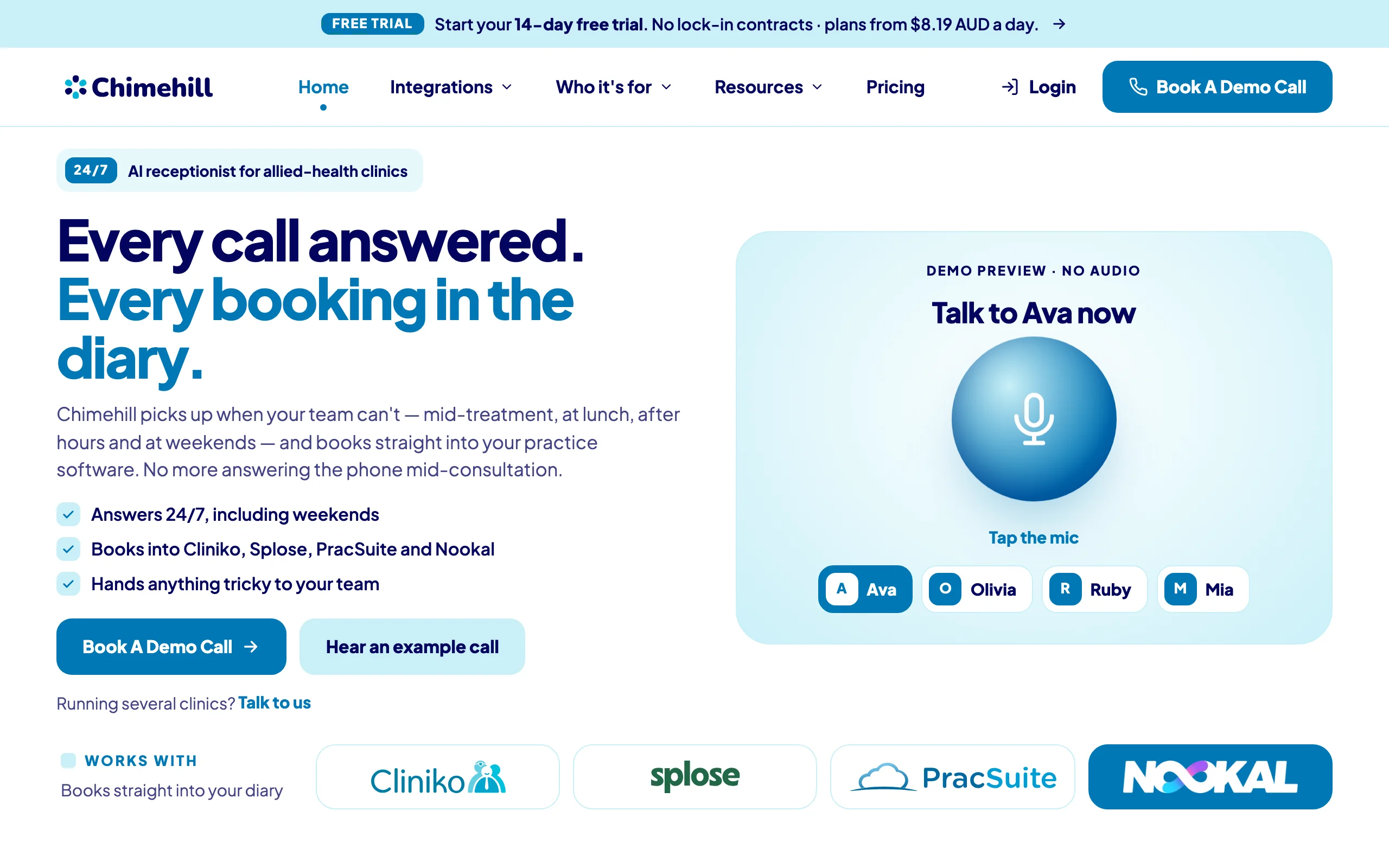
Here's the limit a doctor needs to hear first. Chimehill writes bookings into four systems only (Cliniko, Splose, PracSuite and Nookal), all built for allied health. It doesn't connect to GP and medical software such as EMIS, SystmOne, Best Practice or MedicalDirector, or to US systems like Epic and athenahealth. On a GP or consultant line it takes down what the caller wants, and your receptionist makes or moves the appointment in your own system the next morning. Its prices are in pounds, Australian dollars and NZ dollars, and its site has no HIPAA or BAA wording, so it isn't set up for US offices.
What it handles well is the overnight and weekend backlog that lands on a practice manager's desk. The patient asking whether you bulk bill or what an initial consult costs gets the answer you've approved, and nothing more. The person cancelling Monday's 9:15 gets a callback task with their details. If a caller describes something urgent, the escalation script your practice writes and approves runs, for example telling them to ring 999 or 000. Chimehill doesn't assess symptoms, and it never gives medical advice. Each call is logged with a summary and outcome, and staff get a morning summary to work through.
Key features
- Picks up forwarded calls around the clock, including weekends and public holidays
- Uses only the facts your practice has approved; it won't make up fees, appointment times or policies
- Puts the caller through or creates a callback task as soon as they ask for a person
- Administrative only: no diagnosis, triage or treatment advice
- A summary and outcome for every call, plus a morning roundup
Pricing (as of October 2026)
- 100 calls: £129, A$249 or NZ$249 a month
- 200 calls: £189, A$379 or NZ$379 a month
- 350 calls: £289, A$579 or NZ$579 a month
- Calls over the allowance: £1.60, A$2.70 or NZ$2.70 each
- UK prices are before VAT; Australian and NZ prices are before GST
- Free for the first 14 days on any plan, and no lock-in contract
Chimehill doesn't sell in US dollars. For a rough comparison only: converting the Australian prices at the European Central Bank reference rate for 16 October 2026 (1 AUD = 0.69588 USD) gives about US$173, US$264 and US$403 a month, and about US$1.88 per extra call. Billing stays in AUD, GBP or NZD. The pricing page lists what comes with each plan.
Pros
- Billed per call rather than per minute, so a long, rambling call about a referral costs no more than a quick one
- Prices published in three currencies, with a free trial and no minimum term
- Written rules on what it will and won't say, and a person whenever the caller asks for one
Cons
- No booking into GP, medical or US practice software (only Cliniko, Splose, PracSuite and Nookal), and no HIPAA or BAA wording, which rules it out for US doctors' offices
- English only; most of the US services below also answer in Spanish
If you run private GP or specialist rooms in the UK, Australia or New Zealand and want to hear how it would answer your line, book a demo.
2. Specialty Answering Service: best for practices watching cost per minute that still want live operators, pager dispatch and a BAA in writing
Specialty Answering Service (SAS) is a US answering company with operators on shift every hour of the year and a page written specifically for doctors' offices. You decide what counts as urgent. When a call meets your criteria, SAS patches it through to the doctor or reaches on-call staff by phone, text, pager or email.
Cost is why most practices look at it. SAS bills "1 second at a time", charges nothing for setup and runs month to month, which suits a small practice whose after-hours calls are mostly 40-second pharmacy queries. Its HIPAA page says SAS and the practice can both sign a BAA. Messages carrying patient details go through a secure portal and phone apps instead of ordinary email or text, and a HIPAA setting hides other patients' details from operators. It can schedule, move and cancel appointments in your online scheduling software, but no EHR is named, and it also offers outbound reminder calls.
Key features
- Live operators every hour, with urgent calls patched through to the doctor on call
- On-call staff reached by phone, text, pager or email
- A BAA signed by both parties; patient messages through a secure portal and apps
- Appointment changes in your online calendar and outbound reminder calls
Pricing (as of October 2026)
- Economy: US$44 a month (included minutes not shown), then US$1.54 a minute
- 100 minutes: US$159 a month; US$1.44 per minute over
- 220 minutes: US$269 a month; US$1.44 per minute over
- 500 minutes: US$649 a month; US$1.34 per minute over
- Plans run up to 10,000 minutes; no setup fee; month to month
- Free trial for 14 days or 200 minutes, no credit card needed
Pros
- The cheapest published live minutes in this lineup: roughly US$1.22 to US$1.59 per included minute on the 100- to 500-minute plans, with bigger plans lower still
- Per-second billing keeps short pharmacy and lab calls cheap
- Signs a BAA and dispatches to whoever is on call
Cons
- The Economy plan's included minutes and several fee rows (holidays, weekends, extra lines) are blank on its pricing page, so get them in writing
- No EHR named, and no AI option mentioned
3. PatientCalls: best for US practices that want a medical-only answering service with a BAA in every contract and a choice of flat, per-minute or per-call billing
PatientCalls is a medical answering service with an office in King of Prussia, Pennsylvania. Its home page says it has worked for the medical and healthcare industries for over 20 years, and the client logos on its site include dermatology, orthopaedic and home-care groups. It describes an around-the-clock team that routes patient calls to your on-call staff.
The BAA isn't optional here. Its pricing page says a business associate agreement must be signed alongside the service agreement, and its HIPAA page says it keeps BAAs with every client and subcontractor and posts a copy on a secure link with each monthly invoice. Doctors get messages through PatientNote, its own app: an SMS tells them a message is waiting, and the details themselves stay in the encrypted app, which logs who opened what and when. PatientCalls lists EMR integration with pages for eClinicalWorks and Intergy, though the pages we read don't say what each connection does. Pricing comes in three shapes (flat rate, per minute, or per call with admin work counted in the same unit), and it says it helps you settle on a plan over the first two months.
Key features
- Medical answering with calls routed to your on-call staff, 24/7
- A BAA signed with every contract
- PatientNote secure messaging app, with access logs, at no extra charge
- EMR integration listed, naming eClinicalWorks and Intergy
Pricing (as of October 2026)
- Pricing on request: flat-rate, per-minute or per-call plans
- One-time setup fee of US$75 on the first invoice
- Typical contract 30 days, month to month, with 30 days' notice to cancel
Pros
- Built for medical practices, with the BAA part of the paperwork from day one
- Per-call billing is offered, so transfer time and voicemails don't add minutes
- Messages for doctors stay in an app instead of plain text messages
Cons
- No published plan prices, so you'll need a quote to compare
- No free trial mentioned, and no AI option or Spanish service mentioned on the pages we read
4. Abby Connect: best for small private practices that want people on calls involving patient details and AI on the routine ones
Abby Connect is a US answering service that sells human receptionists and an AI receptionist on one plan. According to its medical page, every one of its receptionists works from a single office in Las Vegas. Nights, weekends, holidays, English and Spanish are part of every plan.
Abby divides calls by what's in them. A patient calling about their own care goes to a person. A caller asking for your fax number or Saturday hours can go to the AI, which is meant for calls with no protected health information, and AI minutes use up your allowance at half the rate. You define what's urgent, and those calls go straight to your on-call clinician at any hour. Its medical page lists SimplePractice, Tebra, DrChrono and Calendly among the tools it works with; the human team books through Calendly while the AI books into "hundreds" of scheduling platforms. Before you sign, find out which half of Abby would be booking into your system.
Key features
- Human and AI receptionists under one plan
- Urgent calls to your on-call clinician at any hour, by your definition of urgent
- Lists SimplePractice, Tebra and DrChrono among its connections, and Abby sets the connection up for you
- English and Spanish included
Pricing (as of October 2026)
- Starter: 50 Abby Minutes for US$165 a month
- Essential: 100 Abby Minutes for US$329 a month
- Professional: 200 Abby Minutes for US$599 a month
- Growth: 500 Abby Minutes for US$1,380 a month; Enterprise quoted
- An Abby Minute equals one human minute or two AI minutes; extra minutes at your plan's rate
- No setup fee; free trial on every plan; month to month
Pros
- Patient-detail calls get a person and routine ones get AI, on a single contract
- Names practice software common in US private practice
- Spanish and out-of-hours cover are in the base price
Cons
- Its HIPAA options are marked "human only", and the pages we read don't mention a BAA
- It doesn't say what each software connection actually does (booking, notes or both), so test yours during the trial
5. Signius: best for multi-doctor practices that need on-call paging and an on-call roster they can edit themselves
Signius is a US answering company whose healthcare service covers medical and dental offices, hospitals and other providers. It describes its staff as 100% US-based across 12 locations and says it has been answering phones since 1929. Medical answering is offered 24/7 in English and Spanish.
The draw for a group practice is the on-call side. Signius patches calls and pages the doctor on call, and the practice can change the on-call roster whenever it likes. That matters in a five-doctor practice where weekend cover gets swapped on a Thursday afternoon. It also books appointments and sends reminders, works with Google Calendar, Calendly and Setmore, and says it works with "EHR/EMR systems" without naming any. Messages are kept in a secure web portal.
Key features
- Call patching and paging to whoever is on call
- An on-call roster the practice edits itself
- Appointment booking and reminders
- English and Spanish, around the clock
Pricing (as of October 2026)
- Starter: US$45 a month with no minutes included, then US$1.35 a minute
- Pro: US$170 a month for 125 minutes, then US$1.25 a minute
- Premier: US$280 a month for 225 minutes, then US$1.25 a minute
- HIPAA compliance listed on every plan; month-to-month agreements
- A week's free trial with no credit card or deposit
Pros
- Paging plus a roster you control, which suits practices with several doctors sharing call
- Low entry price, and about US$1.24 to US$1.36 per included minute on Pro and Premier
- Free trial for a week
Cons
- No BAA on the pages we read, and no EHR named
- Its pricing page doesn't give setup fees or how calls are rounded
6. Nexa: best for larger or growing practices that want a custom-quoted mix of human receptionists and AI, with intake
Nexa is a Phoenix, Arizona company that pairs human receptionists with AI. Healthcare is one of many industries it serves, and its healthcare page describes 24/7/365 cover by US-based, bilingual agents it calls HIPAA-trained.
Plans are counted in voice minutes with live receptionists. Scheduling and reminder or follow-up calls come on every plan; the 300 plan adds patient intake and the 500 plan adds CRM integration. Intake matters for a practice taking new patients, because demographics and insurance details are typed once instead of twice. The healthcare page promises "direct integration with leading healthcare EHR systems" but names none. It also lists nurse triage and on-call doctor services. Those are clinical, so ask who provides them, under whose protocols, and how they're billed.
Key features
- People and AI from the same provider
- Patient intake on the 300 and 500 plans; reminder and follow-up calls on all plans
- English and Spanish, 24/7/365
- EHR integration described, with no systems named
Pricing (as of October 2026)
- Pricing on request for the 100, 300 and 500-minute plans
- Extra minutes billed at your base rate
- A setup fee applies; the amount isn't shown
Pros
- One provider for people and AI as call volume grows
- Intake on the bigger plans saves your front desk re-keying new-patient details
- Bilingual, US-based agents
Cons
- No published prices, and no setup fee amount
- No EHR named and no BAA on the pages we read
7. OhMD: best for specialty and multi-site practices that want AI to answer routine calls and carry them on by text, synced to the EHR
OhMD is patient communication software for US healthcare: two-way texting, AI voice and text, and one inbox for calls, texts, web chat and forms. Its specialty pages cover cardiology, dermatology, gastroenterology, orthopaedics, paediatrics, primary care and more, and its customers include practices, FQHCs and health systems.
There are no outside operators here. OhMD's AI answers routine calls such as scheduling, refill requests, referrals and after-hours calls, and it moves many of them into a text conversation so the patient isn't left waiting on hold or playing phone tag. When a call needs staff, a person takes over the conversation. OhMD says it integrates with 85 EHR and practice management systems and syncs calls and texts back automatically, but it doesn't name them on the pages we read. A standard BAA is part of every agreement. Its FAQ says texting is HIPAA compliant "with the appropriate patient consent for each use case", so plan how you'll collect that consent.
Key features
- AI voice and text answering for scheduling, refills, referrals and after-hours calls
- Two-way texting from your existing landline or VoIP number
- Staff can take over any conversation
- A standard BAA in all agreements; syncs to the EHR
Pricing (as of October 2026)
- Core: from US$300 a month, for texting, a text-enabled landline, calling and voicemail transcription
- Automate: from US$500 a month, adding AI voice and text call handling and appointment scheduling
- Enterprise: custom pricing
- Calling usage is billed separately on Automate and Enterprise
- OhMD prints "$" without a code; its pages are written for US healthcare, so we've used US$
Pros
- Calls and texts in one thread per patient, which suits practices drowning in callbacks
- BAA included on every plan
- Specialty pages for a long list of medical specialties, from cardiology to urology
Cons
- Its pages describe AI plus your own staff, not outside operators, so the hard calls come back to your team
- Usage on top of the monthly fee, and no EHRs named, so ask for a full quote with your call volume
How to choose an answering service for your doctor's office
Two questions narrow this list fast: must a human answer every call, and is the BAA in writing on the provider's own site? After that, it comes down to how each service reaches your on-call doctor and what your call log costs on its plans.
Does every caller need to reach a person?
Practices with many elderly patients, or with callers who are often anxious (paediatrics, oncology), tend to want a human every time. Others are fine with AI taking "what time do you open?" as long as a person is one step away.
- A person on every call: Specialty Answering Service, PatientCalls and Signius.
- People for anything clinical or personal, AI for the rest: Abby Connect and Nexa.
- AI with your own staff stepping in, plus texting: OhMD.
Is the BAA in writing?
Once a service handles patient information for a US practice, you need a BAA. On their own sites, Specialty Answering Service, PatientCalls and OhMD say they sign one. Abby Connect, Signius and Nexa talk about HIPAA but, on the pages we read, say nothing about a BAA. Get the signed agreement before forwarding your line, and ask where messages with names and dates of birth end up: in a secure app such as PatientNote or SAS's portal, or in a doctor's ordinary text messages.
How do they reach the doctor on call?
This is the real difference between a doctors' answering service and a general one. Ask each provider to talk you through one urgent call at 2am: the words that trigger it, who gets paged first, how many retries, how long between them, and who's next if nobody answers. Signius lets you edit the roster yourself. SAS dispatches by phone, text, pager or email. PatientCalls routes to on-call staff and sends message alerts through its app. Abby passes urgent calls to your on-call clinician.
Whoever answers should pass urgent calls on, not decide how urgent they are. That judgement belongs to your physicians and the protocol they sign off.
What does your call log cost on each plan?
The pricing comes in four forms: live minutes (SAS, Signius, Abby), quotes (PatientCalls, Nexa), a platform fee plus usage (OhMD) and per call (Chimehill). On plans up to 500 minutes, live answering here ranges from about US$1.22 per included minute (SAS, 220 minutes) to US$3.30 (Abby, 50 minutes). Rounding matters for doctors, because pharmacy and lab calls are short: SAS bills by the second, and Signius doesn't publish its increment.
Take one full month of after-hours calls, note how many there were and how long each lasted, and price exactly that month on every plan you're weighing. A per-call plan only needs the count; Chimehill's plans show that for practices in the UK, Australia and New Zealand.
Will it work with your EHR and your patients' languages?
If you want bookings made rather than messages taken, ask for a test booking in your own system during the trial, not a demo account. Abby names SimplePractice, Tebra and DrChrono; PatientCalls names eClinicalWorks and Intergy; OhMD says it connects to 85 EHR and PM systems without naming them. SAS and Signius schedule into online calendars, so ask how that reaches your EHR. For Spanish-speaking patients, Abby, Signius and Nexa mention it on their own pages; ask PatientCalls, SAS and OhMD directly. Chimehill answers in English only.
Trial it on nights first
Send only after-hours calls for the first two weeks. Read every message, listen to recordings where the service keeps them, and time how long urgent calls took to reach the doctor on call. Add lunchtime and overflow cover once the morning handover runs smoothly.
Questions doctors' offices ask
What does a doctors answering service do?
It picks up when your front desk can't: overnight, at weekends, over lunch and when every line is busy. Depending on the provider, it takes messages, schedules or moves appointments, and passes urgent calls to the doctor on call under rules your practice sets. Our guide to the 24/7 answering service covers how round-the-clock cover is usually arranged.
Is a HIPAA-compliant answering service the same as one that signs a BAA?
No. "HIPAA compliant" is how a provider describes its own security. A BAA is a contract you both sign, setting out how it protects your patients' information and what happens if it fails to. As of October 2026, Specialty Answering Service, PatientCalls and OhMD say on their own sites that they sign one. Ask any provider for the signed document before you start.
How much does an answering service for doctors cost?
As of October 2026, the lowest published entry prices in this list are US$44 a month (Specialty Answering Service Economy, plus per-minute charges) and US$45 a month (Signius Starter, plus US$1.35 a minute). Plans with live minutes included start at US$159 for 100 minutes (SAS), US$165 for 50 minutes (Abby Connect) and US$170 for 125 minutes (Signius). OhMD's AI call handling starts at US$500 a month plus usage; PatientCalls and Nexa quote. Price a real month of your calls before comparing.
Can an answering service page the doctor on call?
Most medical answering services can. SAS reaches on-call staff by phone, text, pager or email; Signius patches and pages using a roster you edit; PatientCalls routes calls to on-call staff and alerts doctors through its app; Abby sends urgent calls to your on-call clinician. Run a test page during the trial at an awkward hour.
Should a doctor's office use AI instead of live operators?
It depends on who calls you and why. AI is cheaper per call and handles hours, directions and booking requests well, but some patients want a person, and some calls need one. Abby Connect and Nexa mix the two; OhMD keeps your own staff as the human layer. Listen to a sample of last month's calls and count how many really needed a person.
Does Chimehill work for doctors' offices?
For private GPs and specialists in the UK, Australia and New Zealand, it answers calls, gives approved answers, takes messages and passes callers to your staff. It doesn't book into GP or medical software; it books only into Cliniko, Splose, PracSuite and Nookal. It has no HIPAA or BAA wording, so it isn't a fit for US offices. The integrations page lists the systems it connects to.
Do we need a new phone number?
Usually not. Chimehill uses call forwarding from your existing practice number (always, after hours, or when nobody picks up), and most answering services work the same way. Ask each provider how forwarding is set up, then test the rules on your phone system before the first night shift.